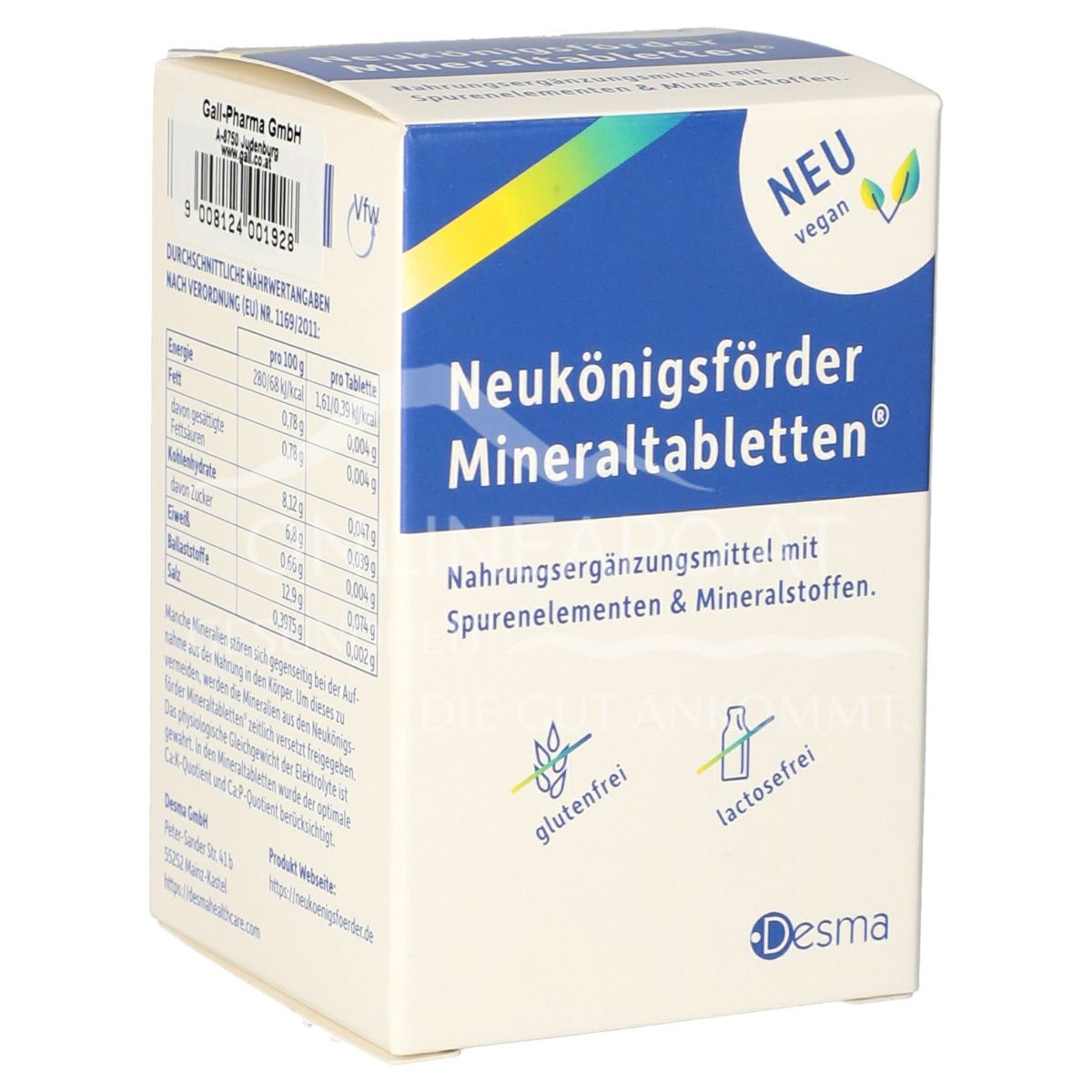
Product information "Neukönigsförder mineral tablets NE 200 pieces"
Neukönigsförder Mineraltabletten® NE
with trace elements
Neukönigsförder Mineral Tablets contain all essential minerals and trace elements in a quantity ratio that should be physiologically present in the blood serum, sufficient to prevent deficiency symptoms in the event of supply gaps.
- Minerals and trace elements in physiological balance
- Positive influence on the acid-base balance
- Suitable for diabetics
- free from gluten, lactose and genetically modified ingredients
Minerals and trace elements act like an elixir of life in the human body, as they are involved in all vital metabolic processes. If they are ingested in insufficient quantities, this can lead to various metabolic disorders and make the organism more susceptible to infections of all kinds.
If there is a deficiency, the first step should be to recognise and eliminate the causes. Those who live on sweets and fast food should be educated about wholefood nutrition. Anyone who abuses laxatives and diuretics needs to change their medication. Those whose pancreas is in hibernation need to wake it up.
If all this does not work, supplementation with conventional mineral supplements, such as Neukönigsförder Mineraltabletten® NE, is an option. Neukönigsförder Mineraltabletten® NE offer a sensible dietary supplement and thus the basis for a long, vital, efficient and healthy life!
Food supplement with minerals
Contents 114.5 g - 200 tablets
Best before: see lid flap and tin label
Recommended intake:
3 x daily 1-2 tablets with plenty of liquid at mealtimes.
The recommended daily intake should not be exceeded.
Food supplements should not be used as a substitute for a balanced diet.
Ingredients:
Potassium chloride, calcium hydrogen phosphate, magnesium hydrogen phosphate, calcium carbonate, sucrose, magnesium oxide, bulking agents croscarmellose sodium and cellulose, gelatine, anti-caking agents polyvinylpyrrolidone and magnesium salts of fatty acidsuren, coating agents talc and hydroxypropyl methylcellulose, ferrous sulphate, colouring agents titanium dioxide, iron oxides and iron hydroxides, zinc oxide, manganese, anti-caking agent silicon dioxide, sunflower oil, dextrose, copper sulphate
1 tablet contains less than 0.001 BE
contain no gluten
do not contain lactose
Note:
In the case of renal insufficiency requiring dialysis (impaired kidney function), the tablet should only be taken under control of blood electrolyte levels.
Desma GmbH
Rheinallee 122, 55120 Mainz
www.desma-pharma.com
General information about minerals
Deficiency - yes or no?
With a balanced, varied diet, it is generally possible to consume adequate amounts of minerals. However, our diet is often different and may not always be sufficient to cover our need for essential minerals and trace elements. If the individual need for minerals - e.g. during pregnancy and breastfeeding, during the growth phase, for competitive athletes and heavy labourers, in old age or after recovering from illness - is not covered by the diet, a deficiency can easily arise.
The "refinement" of our staple foods into a civilised diet is often tantamount to a depletion of minerals. The more wholesome the diet, the lower the need for supplements.
Many modern medicines can cause a mineral deficiency by leaching out or displacing vital minerals and trace elements. Potassium is particularly susceptible to this. The long-term use of laxatives, diuretics, heart and blood pressure medication and many rheumatism drugs often leads to a potassium deficiency.
The vital minerals are "team players". If only one is missing, the function of the others is also impaired. If one is supplied in excess, it displaces others. The physiological balance between the minerals is the prerequisite for regular metabolic functions. Neukönigsförder Mineraltabletten® NE with trace elements provide important minerals in a quantity ratio that also prevails in serum.
Despite the highest precision, blood tests or other analyses say little about the supply situation. Each mineral resides in its specific habitat. Calcium in kilograms in the bones, milligrams in the blood, potassium forty times more in the cells than in the serum, zinc in the prostate and in the eye, but hardly in the blood. Some nutritional deficiencies show up quickly, e.g. potassium in a few days, some only after decades, e.g. calcium in osteoporosis.
It is therefore important to know the metabolic functions of the individual minerals in order to recognise possible deficiencies. If there are indications of an insufficient supply of a mineral, this may also be an indication that the intake of other minerals is not adequate.
What does the body need minerals for?
Potassium:
The potassium concentration inside the nerve cells is responsible for the resting potential of the nerves, i.e. for the ability not to convert all meaningless information into voltage and action potentials. Neuromuscular excitability is stabilised by potassium. This applies equally to the skeletal muscles, intestinal muscles and heart muscles.
The acid-base balance is also influenced by potassium (al kali = Arabic for plant ash). Potassium is mainly contained in plants, so there should be no deficiencies in a balanced plant-rich diet. However, potassium is poorly protected against leaching losses. Deficiencies can occur very quickly when fasting or on a zero diet.
Calcium:
Calcium is needed in large quantities to stabilise the skeleton and teeth, so that pregnant women, children and adolescents have a high requirement, but people in the second half of life must also pay attention to a balanced calcium balance in order to compensate for the increased calcium loss. Bone is not a "dead" tissue, but has a lively metabolism.
Small amounts in the blood are sufficient to convert nerve impulses into appropriate muscle work in the skeletal and heart muscles. Blood coagulation is dependent on calcium in all phases. Calcium seals cell membranes, especially on the histamine-containing mast cells of the skin. The cohesion of cell structures, cell adhesion, is improved by calcium. All digestive enzymes are activated and stabilised by calcium. If not enough calcium is supplied in the diet, the organism covers its needs from the skeletal reserves.
Magnesium:
Like potassium, magnesium is responsible for the resting potential of the nerves, because without magnesium, potassium cannot reach the inside of the cell, where it fulfils its important function. As a natural calcium antagonist, magnesium keeps the muscle contraction triggered by calcium within moderate limits, both in the skeletal muscles and in the hollow organs such as veins, bile ducts and kidney ducts. It is also involved in the storage and release of hormones.
As the nucleus and activator of numerous enzymes, magnesium is jointly responsible for protein synthesis and the breakdown of sugar and fat. As it is the key element in energy metabolism, competitive athletes and heavy labourers also have an increased requirement.
Iron:
Iron is the central component of the red blood pigment. It is required for oxygen transport and oxygen utilisation (respiratory chain) in the body. Skin, hair and nails need iron for their stability and elasticity. Iron has a twofold effect on the immune system: it enables the activity of phagocytes and it binds bacterial toxins.
Zinc:
Zinc activates well over 100 enzymes, such as the one responsible for acid excretion in the kidneys. The prostate is the organ with the highest zinc content. Here, zinc is important for sperm motility and therefore for male fertility.
Zinc plays a key role in the immune system. The formation of phagocytes and immunoglobulins is dependent on a sufficient supply of zinc, as is the stability of histamine-containing mast cells. Maintaining immunocompetence in old age and vitality requires sufficient zinc. The transport protein metallothionein, with which toxic heavy metals are excreted, is controlled by zinc.
Zinc is a component of the enzyme that breaks down alcohol. It is involved in the formation of insulin and is a component of the carbohydrate-digesting enzyme alpha-amylase. Vitamin A can only control the eye's adaptation to light and dark with the help of zinc.
Manganese:
Impaired utilisation of vitamins A and B1, inhibited glutamine synthesis in the brain, thyroid disorders, goitre despite sufficient iodine intake, tooth decay, hypersensitivity, fertility and libido disorders, impaired conversion of lactic acid to glucose.
Copper:
Copper is necessary for the activity of monoamine oxidases, the enzymes that build up and break down the activity hormones noradrenaline and adrenaline. The structure and quality of collagenous connective tissue, i.e. cartilage, intervertebral discs, tendons and ligaments, is also determined by copper.
All energetic iron functions also need copper as a partner. The build-up of immunoglobulins is controlled by copper. The sensation of taste and pigment formation are copper-dependent.
Source: www.desma-pharma.com