
Dr Kottas laxative tea, 20 ST

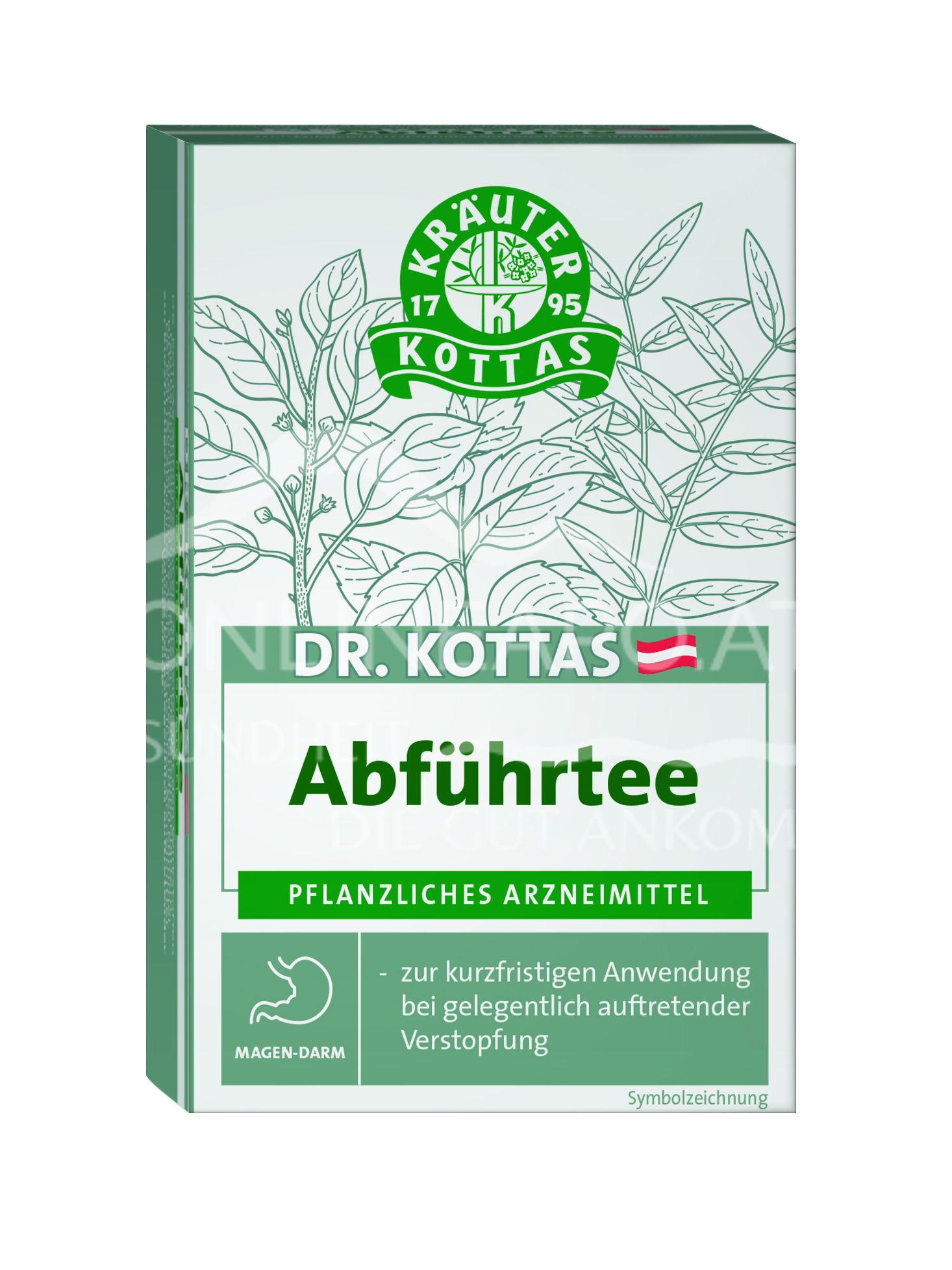
Dr Kottas Laxative Tea is a herbal medicinal tea with the active ingredients buckthorn bark, senna leaves, peppermint leaves, fennel fruits and caraway fruits. For short-term use for occasional constipation.
€6.40
(May vary by country)
Available, delivery time: 1-3 days ⁴
No parcel tax applies to your order from Onlineapo.at.
Dr Kottas’s Laxative Tea is a herbal medicinal tea containing the active ingredients buckthorn bark, senna leaves, peppermint leaves, fennel seeds and caraway seeds. Dr Kottas’s Laxative Tea is a herbal medicinal product for use in cases of constipation, particularly where accompanied by cramp-like symptoms.
Buckthorn (Cortex Frangulae)
- Buckthorn is a thornless shrub growing to a height of 1 to 3 metres, or, more rarely, a small tree. The inconspicuous flowers, arranged in corymbs, produce spherical fruits which are initially green, later turn red and, when ripe, become black-purple. The fresh bark, the fruits and the leaves are poisonous! The bark is used medicinally. It must be stored for at least one year before use.
- Effect: Buckthorn bark is a mild, natural laxative that acts in the large intestine. It is also used to relieve flatulence.
Senna leaf (Folium Sennae, Fructus Sennae angustifoliae, Fructus Sennae acutifoliae)
- The leaves and fruits used medicinally come from two different species. Both are shrubs growing to a height of 0.5 to 1.5 m. The flowers of both species are yellow, axillary and arranged in clusters. These develop into broad, flat, brown, kidney-shaped pods containing 7 to 10 seeds.
- Effect: Senna leaves are among the most reliable laxatives. The fruits also have a laxative effect, but are milder in action. They accelerate gastrointestinal transit and increase the water content of the stools. Because they produce soft stools, senna leaves and fruits can also be used to treat anal fissures, haemorrhoids and following surgical procedures.
Peppermint (Folium Menthae piperita)
- Peppermint is a naturally occurring hybrid of two mint species (M. spicata and M. aquatica). It is sterile, meaning it cannot reproduce naturally. It was first discovered in England in 1696 in a field of spearmint and has been cultivated as seedlings ever since. It grows up to 90 cm tall and contains essential oil. The leaves give off a characteristic scent when crushed.
- Effects: The main active ingredient in peppermint is essential oil, particularly menthol. Peppermint leaves are used to treat colds and headaches; they also relieve cramp-like symptoms in the gallbladder area and the gastrointestinal tract.
Fennel (Fructus Foeniculi amari)
- Fennel is an annual or perennial plant, anchored in the ground by a usually fleshy root and capable of growing up to 2 m tall. The stems are branched at the top and bear pinnately compound leaves. The small, yellow flowers bloom from July to September and are arranged in umbels. The oil extracted from the fenchone-rich fruits is used medicinally.
- Effect: Helps with digestive complaints, bloating, flatulence and cramp-like symptoms in the gastrointestinal tract (particularly in infants and young children) and aids in loosening mucus in cases of catarrh of the upper respiratory tract.
Caraway (Fructus Carvi)
- The plant is a biennial, growing to a height of 30 cm to 100 cm, and is found in poor meadows, pastures and on roadsides. It is characterised by its aromatic scent and caraway flavour. The caraway used medicinally comes from cultivated plants.
- Effect: The most important active ingredient in caraway is its essential oil, which consists largely of carvone. Carvone is reported to have antimicrobial, antispasmodic and carminative effects. Caraway is the best herbal carminative (a remedy for flatulence). It is also used to relieve symptoms such as bloating, mild cramp-like gastrointestinal disturbances and digestive problems in infants.
Dosage form
Tea bags
Directions for use
- Adults: 1–2 cups of tea once a day.
- To achieve the desired effect in the morning, drink 1 cup in the evening before going to bed. In cases of severe constipation, a second cup should be drunk in the morning.
- For each cup (125 ml), pour boiling water over 1–2 tea bags, cover and leave to infuse for 10–15 minutes. Then squeeze the tea bags well and drink the tea lukewarm in small sips. The tea may be sweetened to taste.
- If symptoms worsen or there is no improvement after 7 days, consult a doctor.
- Must not be taken for a prolonged period (more than 1–2 weeks) without a doctor’s prescription.
Notes:
- Dr Kottas’s Laxative Tea must not be taken if you are hypersensitive (allergic) to any of the active ingredients, or in cases of intestinal obstruction, acute inflammatory bowel disease, or abdominal pain of unknown cause.
- Taking Dr Kottas’s Laxative Tea with other medicines: In the event of significant potassium loss, the effect of cardiac glycosides may be enhanced. Certain medicines (carbenoxolone, corticosteroids and thiazide diuretics) may increase the risk of potassium loss.
- Pregnancy and breastfeeding: As there is insufficient data available, use during pregnancy and whilst breastfeeding is not recommended.
Ingredients
1 tea bag contains 0.74 g buckthorn bark (Frangulae Cortex), 0.76 g senna leaves (Sennae Folium), 0.30 g peppermint leaves (Menthae piperitae Folium), 0.16 g fennel fruit (Foeniculi Fructus), 0.04 g caraway fruit (Carvi Fructus)
| Alcohol-free: | Not specified |
|---|---|
| Gluten-free: | Not specified |
| Lactose-free: | Not specified |
| Perfume: | Not specified |
| Piece: | 20 |
| Sugar-free: | Not specified |
| Vegan: | Not specified |
Instructions for use
| Type of use: | 1 Filterbeutel pro Tasse mit ¼ Liter kochendem Wasser übergießen, 10-15 min ziehen lassen, Tee trinken |
|---|---|
| Field of use: | Traditionell pflanzlich bei gelegentlich auftretender Obstipation |
| Dosage: | Nur zur kurzfristigen Anwendung Personen ab 12 Jahren Abends 1mal tgl 1 Tasse, MTD 2 Tassen Wirkungseintritt nach 8-12 Std Nicht für Kinder |
| Properties and efficacy: | Pflanzliches Laxans |
| Contraindications: | LogImport.sisx.GAD.Ileus, Darmstenose und -atonie, Appendizitis, entzündliche Darmerkrankungen z B Morbus Crohn, Colitis ulcerosa, unklares Abdomen, schwere Dehydratation, Anwendung bei Kindern |
| Habituation effects: | LogImport.sisx.GED.Missbrauch möglich |
| Side effects: | MagenDarm Durchfall, Pseudomelanosis coli, Allergien, Urinverfärbung, Verstärkung von Sodbrennen, Reflux Elektrolytverluste Kalium, Hämaturie bei Missbrauch |
| Special warnings for safe use: | Ohne ärztliche Anordnung max 1-2 Wochen anwenden Bei gastroösophagealem Reflux nicht anwenden Vorsicht bei Gallenleiden, Nierenerkrankungen |
| Interactions: | Bei Kaliumverlust durch chronischen GebrauchMissbrauch Herzglykoside, Antiarrhythmika, QT-verlängernde Substanzen verstärkt Diuretika, Kortikoide oder Süßholzwurzel verstärken Kaliumverlust |
| Pregnancy and breastfeeding period: | Gegenanzeige |
Pregnancy information
| Use forbidden |
|---|
Breastfeeding information
| Breastfeeding forbidden |
|---|
Customers also bought
Sofort verfügbar
Content: 30 Stück
€16.91* €19.90*

Lagernd
Content: 20 Stück
from €34.95*
Sofort verfügbar
Content: 20 Stück
€6.40*

Lagernd
Content: 10 Milliliter
€19.90*
Lagernd
Content: 30 Stück
from €6.00*