
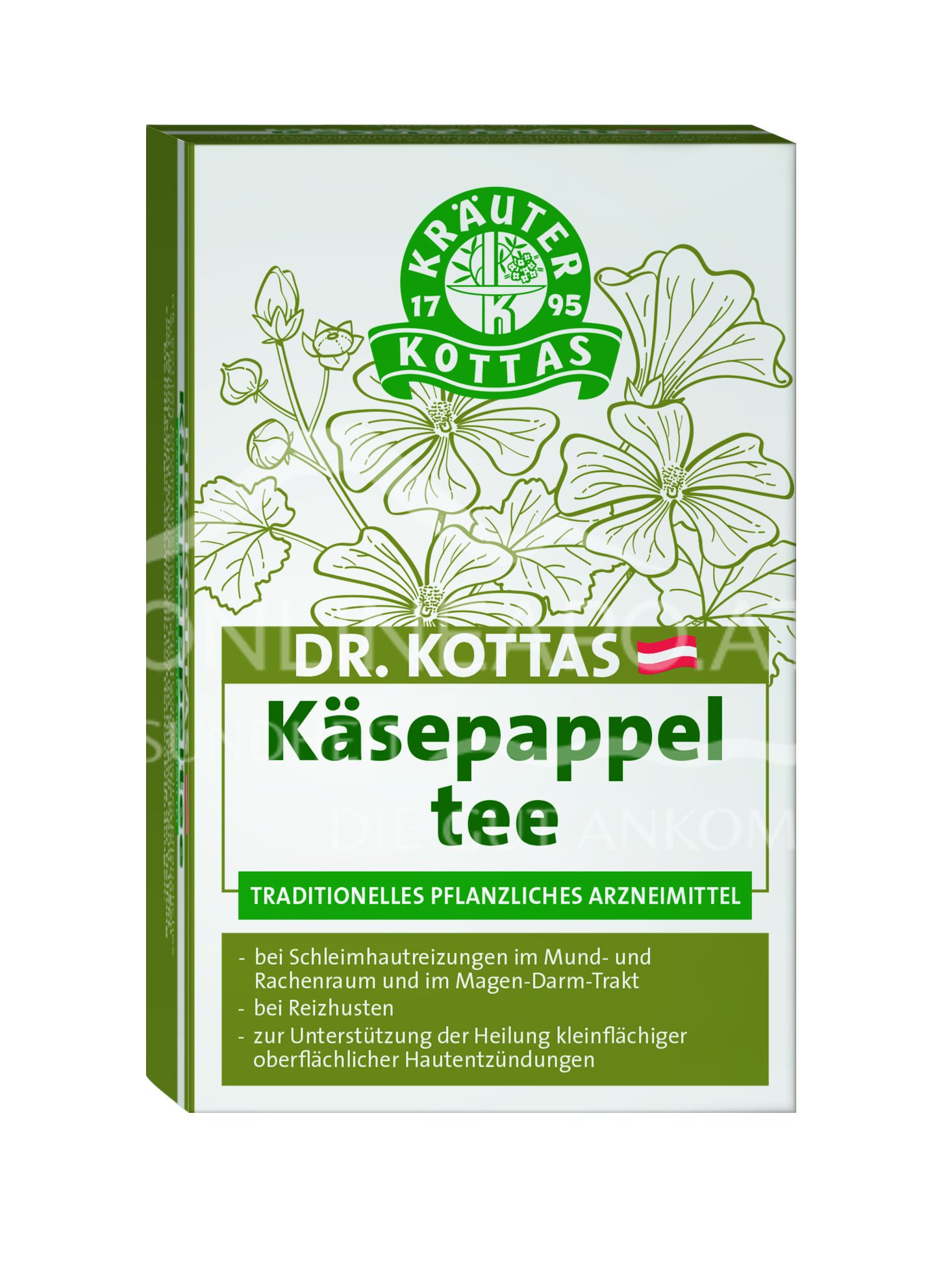
Dr Kottas gastrointestinal tea, 20 ST

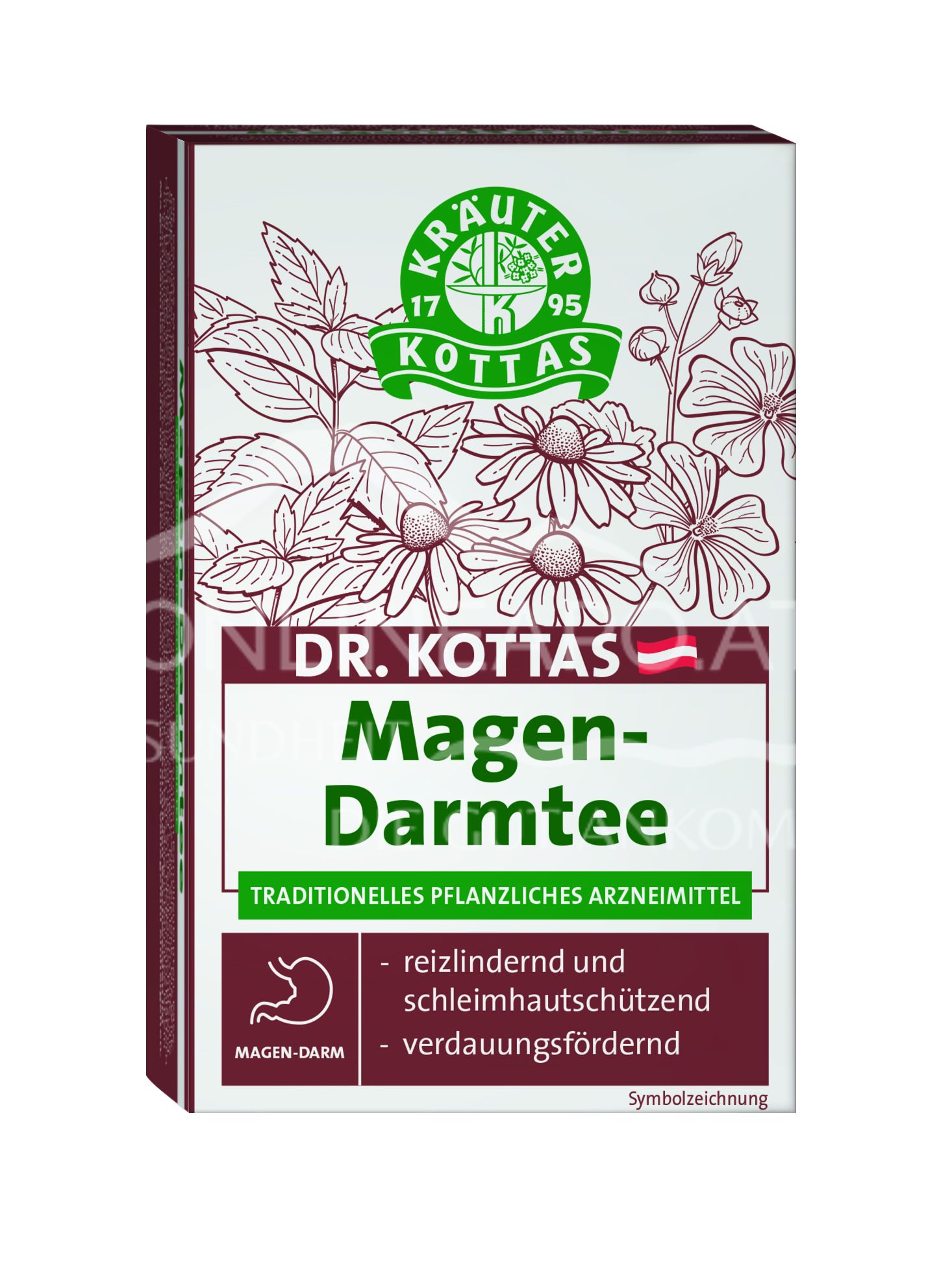
DR. KOTTAS Gastrointestinal Tea is a medicinal tea with the active ingredients camomile blossoms, cheese poplar leaves, centaury, peppermint leaves and calamus rhizome. For use in mild gastrointestinal complaints.
€6.40
(May vary by country)
Available, delivery time: 1-3 days ⁴
No parcel tax applies to your order from Onlineapo.at.
Dr Kottas’ Gastrointestinal Tea is a medicinal tea containing the active ingredients chamomile flowers, black poplar leaves, centaury, peppermint leaves and calamus rootstock.
The active ingredients in chamomile flowers have anti-inflammatory properties. The mucilage contained in the black poplar leaves soothes irritation and protects the mucous membranes. The bitter compounds in centaury, together with the essential oils from peppermint leaves and calamus rhizome, aid digestion.
Dr Kotta’s Gastrointestinal Tea is a traditional herbal medicinal product for use in cases of mild
gastrointestinal complaints associated with mild cramps, flatulence and a feeling of fullness.
The use of this traditional herbal medicinal product for the aforementioned indications is based solely on long-standing use.
Chamomile (Flos Chamomillae vulgaris)
- True chamomile is an annual plant with an erect, usually branched stem; it grows in barren habitats. The narrow, two- to three-pinnately compound leaves are borne singly at the tips of the branched shoots. The flower head consists of a ring of white ray florets and 400 to 500 yellow, tubular disc florets. When crushed, the flowers give off a pleasant, aromatic scent.
- Effects: Chamomile is used both internally and externally. Thanks to its beneficial properties for wound healing, it is used to treat inflammation of the skin and mucous membranes, including the mouth and gums. When taken as a tea, it provides rapid relief from stomach, intestinal and menstrual complaints.
Mallow or cheese poplar (Folium Malvae, Flos Malvae)
- Sunny slopes, the edges of paths, fields and meadows, and walls are the favourite habitats of the mallow or cheese poplar, which flowers from June to August. The flowers are a deep violet colour. Only the leaves and flowers, which are collected on dry days and carefully dried, are used.
- Effect: Mallow soothes irritation of the mucous membranes of the upper respiratory tract and the mouth and throat, as it contains an exceptionally high amount of mucilage, which coats the inflamed tissue like a protective film. It is used medicinally for a hoarse voice, laryngitis and hoarseness. Mallow or cheese poppy tea has the same effect (protective film) on the inflamed mucous membranes of the stomach and intestines.
Centaury (Herba Centaurii)
- This biennial plant, which grows up to 50 cm tall, is native to the whole of Europe and comprises several subspecies. In the first year, a basal rosette of leaves appears; only in the second year does an erect, branched, flower-bearing stem form. The pale pink to red flowers form a corymb. The dried, flowering herb is used medicinally.
- Effect: The bitter compounds are the main active ingredients in centaury. It is used to treat indigestion, weak digestion with insufficient gastric juice secretion, flatulence, stomach cramps and to stimulate the appetite.
Peppermint (Folium Menthae piperita)
- Peppermint is a naturally occurring hybrid of two mint species (M. spicata and M. aquatica). It is sterile, i.e. it cannot reproduce naturally. It was first discovered in England in 1696 in a field of spearmint and has been cultivated as seedlings ever since. It grows up to 90 cm tall and contains essential oil. The leaves give off a characteristic scent when crushed.
- Effects: The main active ingredient in peppermint is essential oil, particularly menthol. Peppermint leaves are used to treat colds and headaches; they also relieve cramp-like symptoms in the gallbladder area and the gastrointestinal tract.
Dosage form
Tea bags
Usage
- Adults: 1 cup of tea 3–4 times a day after meals
- Young people (aged 12–18): 1 cup of tea up to 3 times a day after meals
- For each cup (125 ml), pour boiling water over 1 tea bag, cover and leave to infuse for 10 minutes. Then squeeze the tea bag well and drink the tea lukewarm in small sips. The tea may be sweetened to taste.
- If symptoms worsen or there is no improvement after 14 days, consult a doctor.
- Not recommended for children under 12 years of age, as there is insufficient data available.
Notes:
Dr Kottas’ Gastrointestinal Tea must not be taken:
- if you are hypersensitive (allergic) to any of the active ingredients, or to composite flowers and menthol .
- if you suffer from stomach ulcers.
- Special care is required when taking Dr Kottas Gastrointestinal Tea: Patients with gastro-oesophageal reflux disease (backflow of gastric juice into the oesophagus) should avoid peppermint, as it may worsen heartburn. Patients with gallstones or other gallbladder disorders should exercise caution when taking this product.
- Side effects: Gastro-oesophageal reflux disease (backflow of gastric juice into the oesophagus) may worsen and heartburn may be exacerbated by taking this product.
Ingredients
1 tea bag contains: 0.1 g chamomile flowers (Matricariae flos), 0.84 g mallow leaves (Malvae folium), 0.056 g centaury (Centaurii herba), 0.252 g peppermint leaves (Menthae piperitae folium), 0.112 g calamus rhizome (Calami rhizoma)
| Alcohol-free: | Not specified |
|---|---|
| Gluten-free: | Not specified |
| Lactose-free: | Not specified |
| Perfume: | Not specified |
| Piece: | 20 |
| Sugar-free: | Not specified |
| Vegan: | Not specified |
Instructions for use
| Type of use: | Pro Tasse 1 Filterbeutel mit kochendem Wasser übergießen, 10 min zugedeckt ziehen lassen, Filterbeutel gut ausdrücken und den Tee lauwarm schluckweise trinken |
|---|---|
| Field of use: | Traditionell pflanzlich bei Dyspepsie, Blähungen, leichten Spasmen |
| Dosage: | Erwachsene 3-4 mal tgl nach den Mahlzeiten 1 Tasse Jugendliche 12 - 17 Jahre 3mal tgl 1 Tasse Für Kinder nicht empfohlen |
| Properties and efficacy: | Reizlindernd, schleimhautprotektiv, verdauungsfördernd |
| Contraindications: | LogImport.sisx.GAD.Aktive peptische Ulzera |
| Side effects: | Allergische Reaktionen, Verschlimmerung Sodbrennen, Reflux |
| Special warnings for safe use: | Vorsicht bei gastroösophagealem Reflux, Gallenleiden |
| Pregnancy and breastfeeding period: | Nicht empfohlen Keine Daten vorliegend |
Pregnancy information
| No precise statement can be made. |
|---|
| Use forbidden |
Breastfeeding information
| No precise statement can be made. |
|---|
| Breastfeeding forbidden |
Pictograms
| Take after meals |
|---|
Customers also bought
Sofort verfügbar
Content: 20 Stück
€6.40*

Sofort verfügbar
Content: 20 Stück
€6.31*
Sofort verfügbar
Content: 20 Stück
€6.31*
Sofort verfügbar
Content: 20 Stück
€6.40*
Sofort verfügbar
Content: 20 Stück
€5.31*

Sofort verfügbar
Content: 20 Stück
€6.31*