
D3 Kwizda 3,000 I.U. Tablets, 56 ST

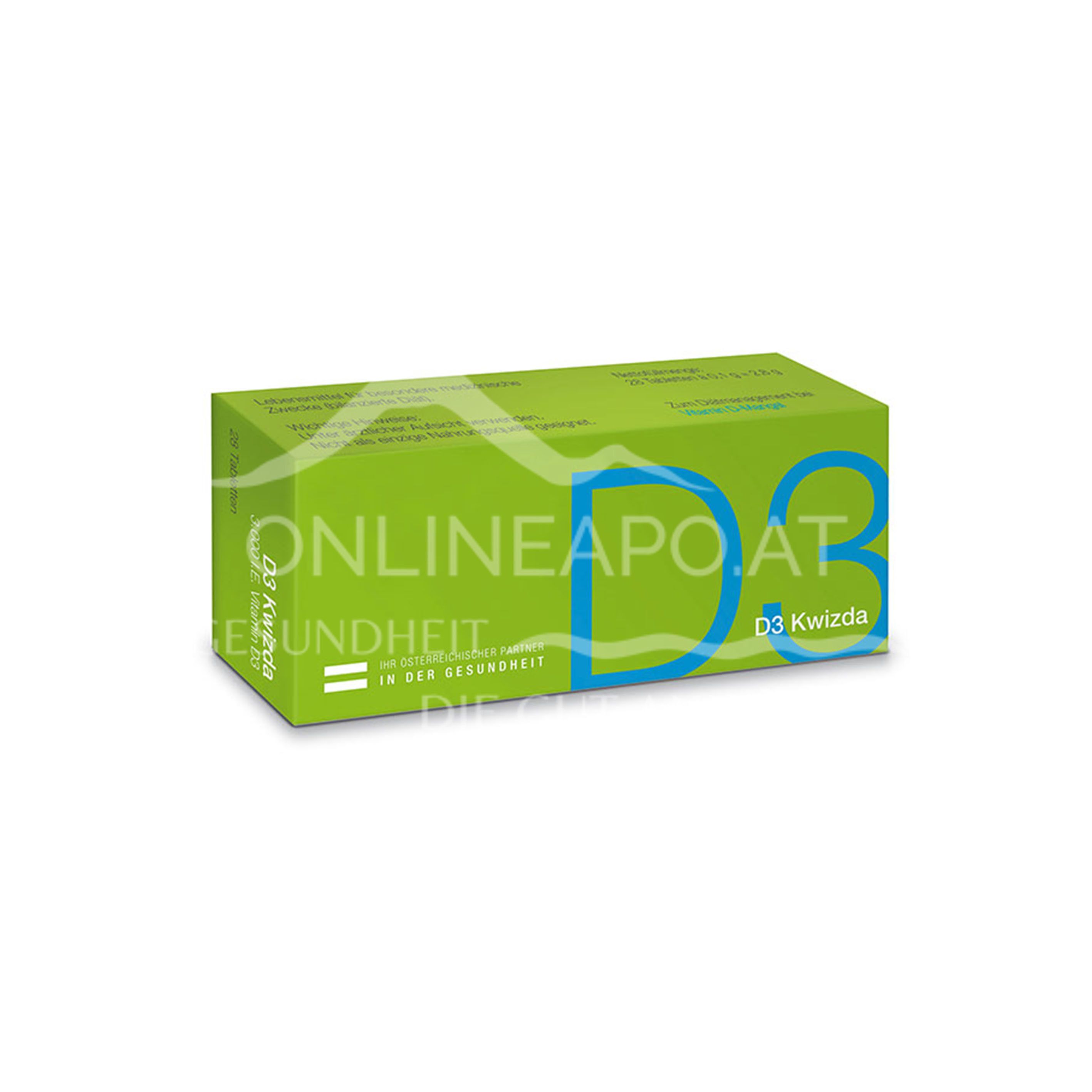
D3 Kwizda 3,000 I.U. Tablets are a food for special medical purposes (balanced diet) for the dietary management of vitamin D deficiency.
€31.70
(May vary by country)
Ready to ship in 1-3 working days ⁴
No parcel tax applies to your order from Onlineapo.at.
D3 Kwizda 3,000 I.U. tablets are a food for special medical purposes (balanced diet) for the dietary management of vitamin D deficiency.
Why is D3 Kwizda taken?
D3 Kwizda is a food for special medical purposes (balanced diet) for the dietary management of vitamin D deficiency. Such foods provide you with nutrients that are suitable in the dosage offered for diet management in connection with a disease or deficiency.
How is vitamin D formed?
Provitamin D, the precursor to vitamin D, is formed in the skin with the help of UVB rays from sunlight. Provitamin D is then converted into vitamin D (= cholecalciferol) by body temperature. The vitamin D formed in the skin under the influence of UV light or alternatively ingested with food is transported to the liver. Vitamin D is converted into its active form (dihydroxycholecalciferol or calcitriol) in the liver and finally in the kidneys. In this active form, it can fulfil its function in the metabolism. Vitamin D deficiency occurs when the amount ingested with food or produced in the body is not sufficient to fulfil its function. The deficiency can be compensated for by a targeted vitamin D intake.
Which foods provide vitamin D?
Approximately 10% of the vitamin D required can be supplied to the body through food. Only a few foods are rich in vitamin D, many of which are not available or consumed in large quantities, such as fatty fish (salmon, herring and mackerel) and egg yolk or appropriately fortified oils and margarine. The contribution of food to compensating for a vitamin D deficiency is therefore small.
What effects of vitamin D have been scientifically investigated?
Even in the past, vitamin D played an indispensable role in the treatment of osteoporosis and rickets, for example. As almost all body cells have vitamin D receptors, the spectrum of effects is correspondingly broad. This is why many medical specialities are concerned with the importance of vitamin D for the human organism and the effects that a vitamin D deficiency can have on health. Numerous current scientific studies show a connection between vitamin D deficiency and various diseases.
Which diseases are associated with vitamin D deficiency?
- rickets
- Osteoporosis
- Flu-like infections
- Influenza
- High blood pressure
- Diabetes (type 1 & 2)
- Heart attack
- Stroke
- Functional limitations of the musculoskeletal system
- Muscle weakness
- rheumatism
- fatigue
- depression
- Alzheimer's disease
- Parkinson's disease
- multiple sclerosis
- Carcinomas
Dosage form
tablets
Directions
Take 1 tablet once daily with meals with sufficient liquid (swallow or chew).
Ingredients
- Ingredients: Lactose (40 mg per tablet); bulking agent: cellulose; maltodextrin; carrier: modified starch (from maize); sucrose; anti-caking agents: silicon dioxide, magnesium salts of fatty acids; cholecalciferol Net quantity: 28 or 56 round, white tablets with one-sided notch, each 0.1 g = 2.8 g or 5.6 g.
- Nutritional information per tablet: calorific value 3 kJ/1 kcal, fat < 0.1 g of which saturated fatty acids < 0.1 g, carbohydrates < 0.1 g of which sugar < 0.1 g, protein < 0.1 g, salt < 0.01 g, vitamin D 75 µg. (75 µg vitamin D3 = 3,000 I.U.) 3,000 I.U. vitamin D3 corresponds to 375% of the recommended daily intake according to D-A-CH reference values 2013.
| Fructose free: | Yes |
|---|---|
| Gluten-free: | Yes |
| Piece: | 56 |
1 review
25 January 2026 18:23
Basis Supplement im Winter
Ich nehme es zur Unterstützung meines Immunsystems und für Muskeln und Knochen, vor allem im Winter essentiell.
Instructions for use
Customers also bought
Sofort verfügbar
Content: 30 Stück
€40.05* €44.50*
Lagernd
Content: 30 Stück
€14.50*
Lagernd
Content: 24 Stück
€95.40*
Lagernd
Content: 90 Stück
from €19.95*