
CorDx influenza test A + B, COVID-19, RSV, combination test 4in1, 1 ST

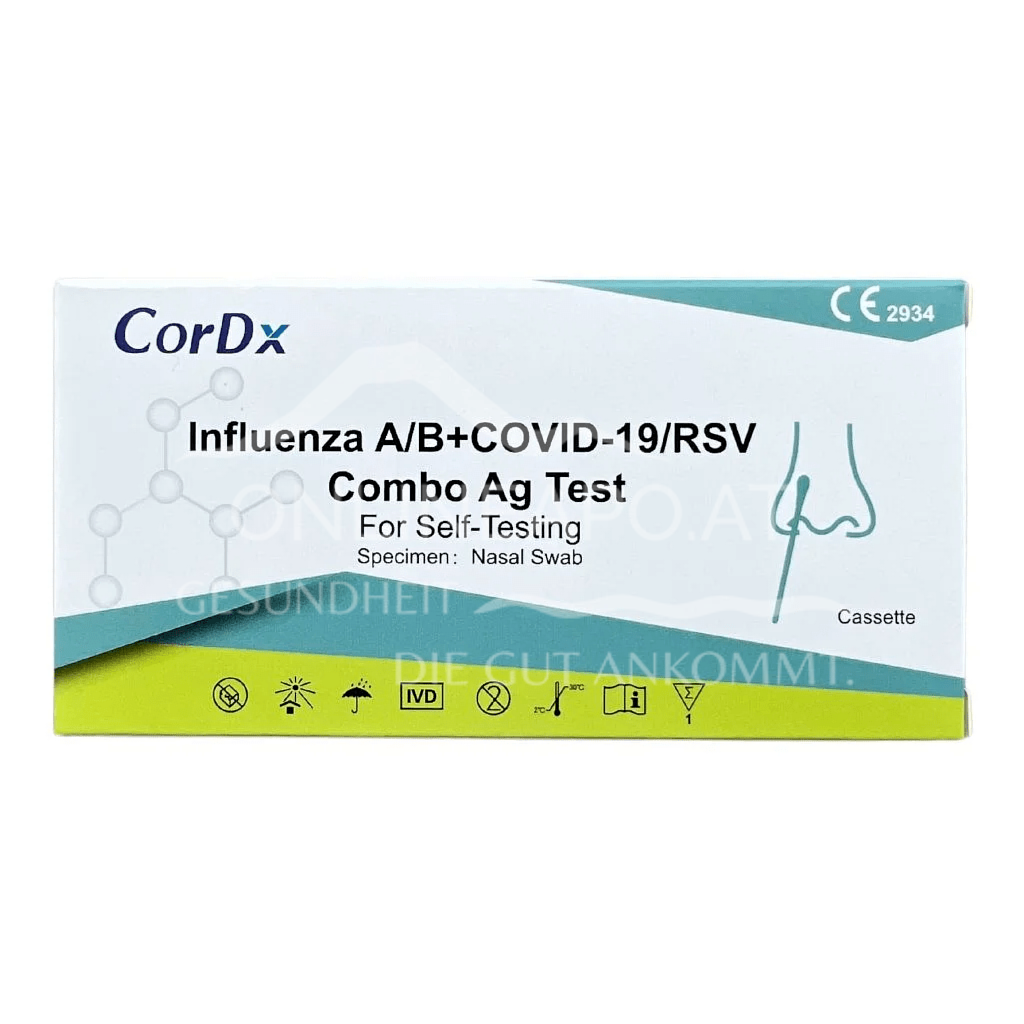
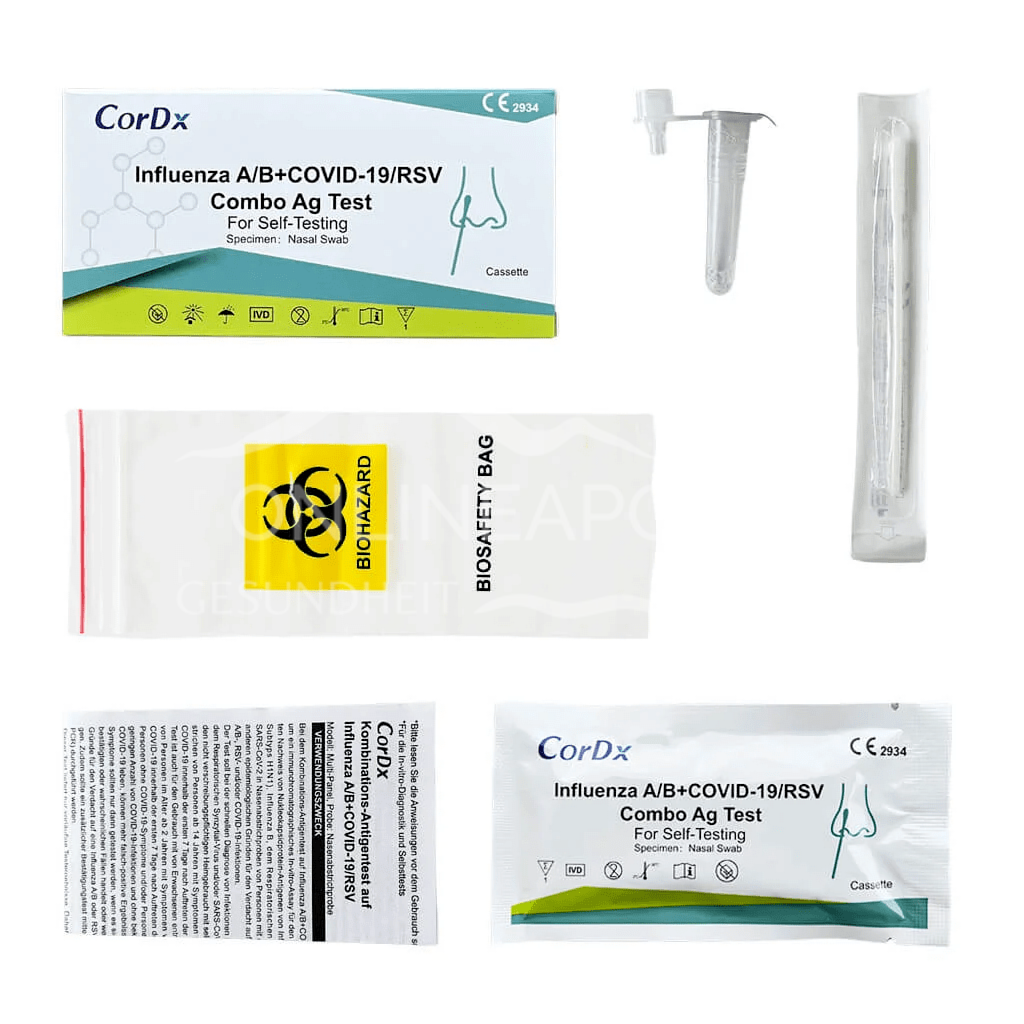

CorDx Influenza Test A + B, COVID-19, RSV, Combi Test 4in1 is an antigen test. Covid, influenza A/B and RSV can be detected within 15 minutes using a simple nasal swab.
€6.51
(May vary by country)
Ready to ship in 1-3 working days ⁴
No parcel tax applies to your order from Onlineapo.at.
- Quick to carry out: The test can be completed within a few minutes.
- 4-in-1 combination test: Covid, influenza A/B and RSV
- Results available after 15 minutes
- Easy to use: The test is straightforward to carry out. Simple nasal swab.
- Storage at 2–30 °C CE certified Clinically tested
- Includes all necessary supplies
- Influenza A: For the detection of the Influenza A antigen, the positive concordance rate is 100.00 per cent, the negative concordance rate is 99.34 per cent and the overall concordance rate is 99.43 per cent.
- Influenza B: For Influenza B antigen detection, the positive concordance rate is 96.00 per cent, the negative concordance rate is 99.67 per cent and the overall concordance rate is 99.15 per cent.
- RSV: For RSV antigen detection, the positive concordance rate is 98.98 per cent, the negative concordance rate is 99.21 per cent and the overall concordance rate is 99.14 per cent.
- COVID-19: For COVID-19 antigen detection, the positive concordance rate is 89.09%, i.e. 98.67% for Ct ≤ 25, 93.00% for Ct ≤ 30; the negative concordance rate is 100.00% and the overall concordance rate is 97.86%.
- Influenza A: 1.5×10⁴ TCID₅₀/mL
- Influenza B: 1.5×10⁵ TCID₅₀/mL
- COVID-19: 200 TCID₅₀/mL
- RSV: 1.0×10⁴ TCID₅₀/mL
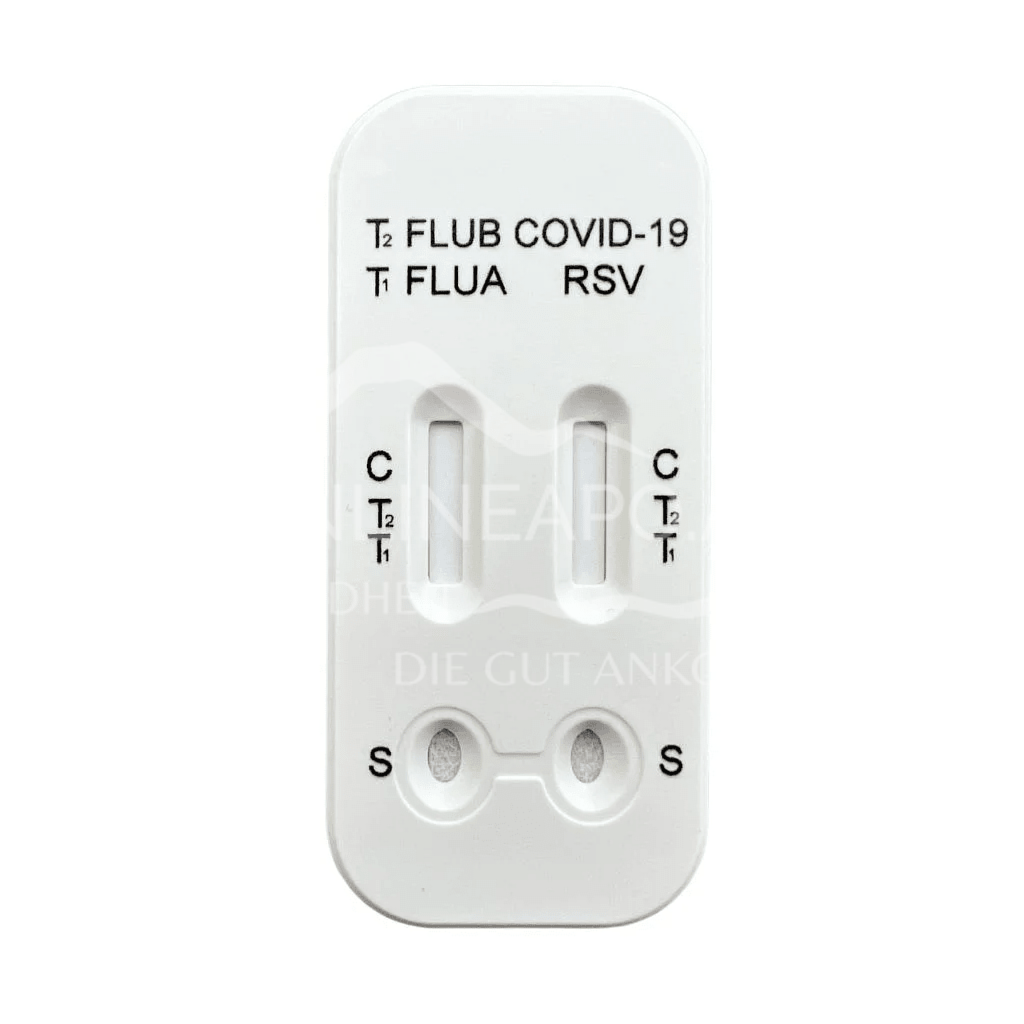
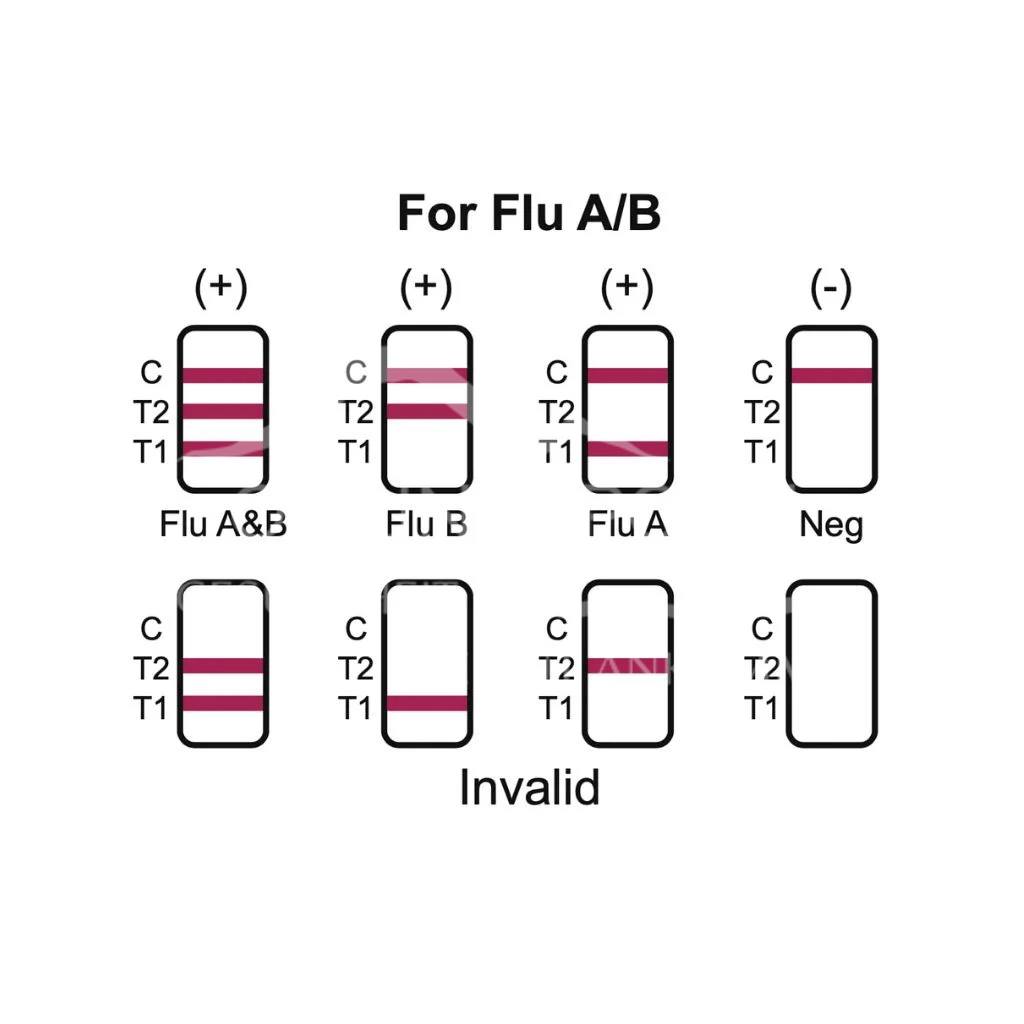
- The Influenza A and Influenza B antigen test strip utilises monoclonal mouse anti-influenza A antibodies (T1), monoclonal mouse anti-influenza B antibodies (T2) and polyclonal goat anti-mouse IgG antibodies (C), each of which is immobilised on a nitrocellulose membrane. The test uses colloidal gold to label the monoclonal mouse anti-influenza A antibodies and the monoclonal mouse anti-influenza B antibodies. It utilises nanocolloidal gold technology and relies on highly specific antibody-antigen reactions, as well as the principle of immunochromatographic analysis. During testing, the influenza A antigens in the sample combine with the colloidal gold-labelled monoclonal mouse anti-influenzaA antibodies to form a complex, which then binds during chromatography to the monoclonal mouse anti-influenza A antibodies coated on the T1 test line, forming a red line in the T1 line.
- During testing, the influenza B antigens in the sample bind, in combination with the colloidal gold-labelled monoclonal mouse anti-influenzaB antibodies to form a complex, which then binds during chromatography to the monoclonal mouse anti-influenza B antibodies coated on the T2 test line, producing a red line in the T2 line. If the samples do not contain influenza type A or B antigens, no red lines will appear in the T1 and T2 regions. Regardless of the presence of influenza type A or B antigens in the sample, a red line should always appear in the quality control region (C) where possible. The red line in the quality control area (C) serves to verify that 1. a sufficient sample volume has been added, 2. an adequate flow rate has been achieved, 3. and acts as a quality control for the reagents.
- The COVID-19, RSV Antigen Test Strip utilises monoclonal mouse anti-COVID-19 antibodies (T2), monoclonal mouse anti-RSV antibodies (T1) and polyclonal goat anti-mouse IgG antibodies (C), each of which is immobilised on a nitrocellulose membrane. It uses colloidal gold to label the monoclonal mouse anti-COVID-19 antibody and the monoclonal mouse anti-RSV antibody. This utilises nanocolloidal gold technology and employs highly specific antibody-antigen reactions, as well as the principle of immunochromatographic analysis technology. During testing, the COVID-19 antigen in the sample binds to the colloidal gold-labelled monoclonal mouse anti-COVID-19 antibody to form a complex, which is then combined with the monoclonal mouse anti-COVID-19 antibody, which was applied to the T2 test line during chromatography; at this point, a red line appears in the T2 area (the test is positive).
- The RSV antigen in the sample binds to the colloidal gold-labelled monoclonal RSV antibody to form a complex, which is then bound to the monoclonal mouse anti-RSV antibody, which was coated onto the T1 test line during chromatography; at this point, a red line appears in the T1 region (the test is positive). If the samples do not contain COVID-19 or RSV antigens, no red lines appear in the T1 and T2 regions (the test is negative). Regardless of the presence of COVID-19 or RSV viral antigens in the sample, a red line always forms in the quality control region (C). The red line in the quality control zone (C) serves to verify that 1. a sufficient sample volume has been added, 2. proper flow has been achieved, and 3. as a quality control for the reagents. If this line does not appear, the test must not be interpreted.
Form of supply
Use
| Piece: | 1 |
|---|
Instructions for use
Customers also bought

Lagernd
Content: 100 Stück
€2.75*
Sofort verfügbar
Content: 10 Stück
from €8.55* €9.50*
Sofort verfügbar
Content: 20 Stück
from €7.60* €11.95*
Sofort verfügbar
Content: 20 Milliliter
€19.90*