
PolyVar® Yellow 275 mg impregnated strip for the beehive, 10 ST

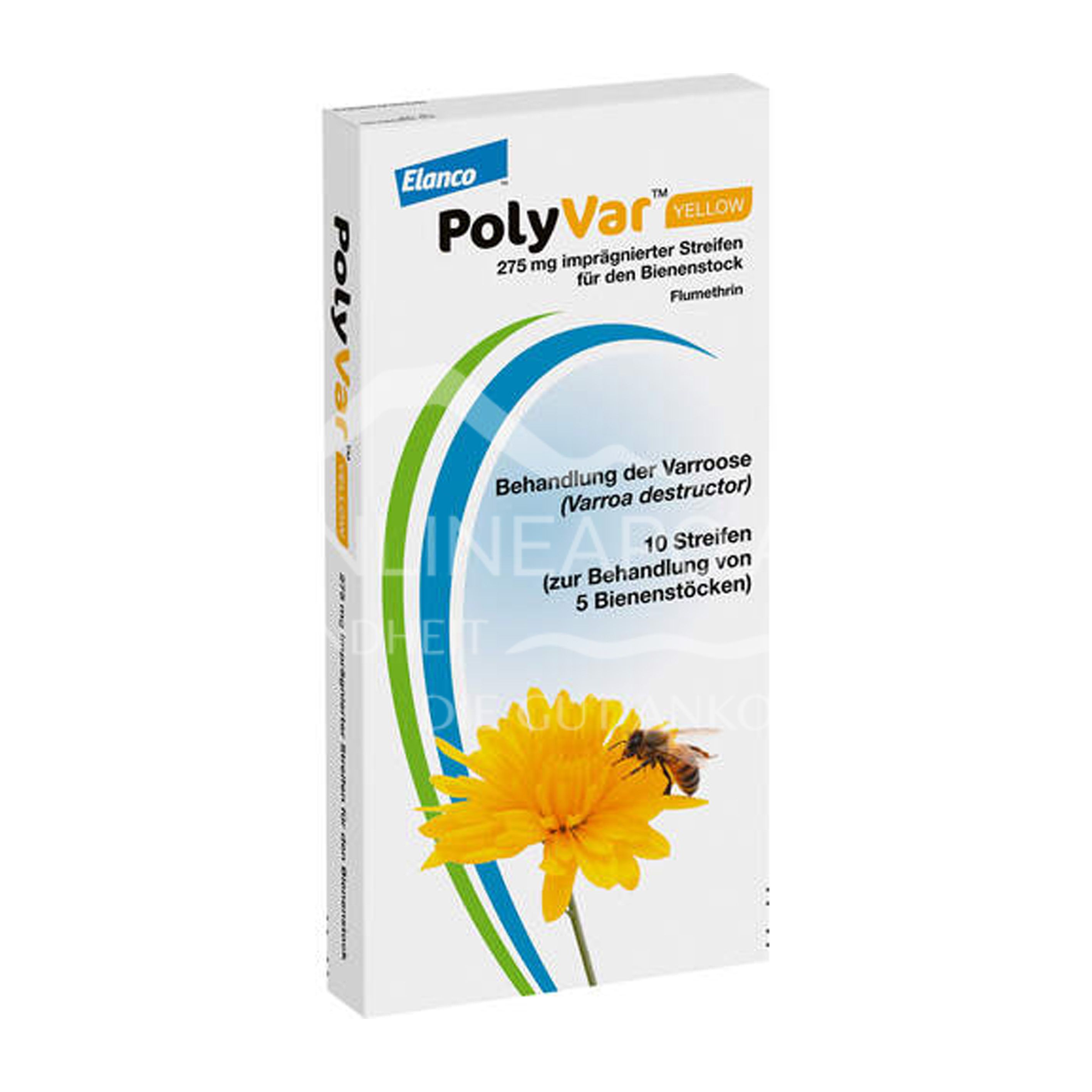
PolyVar® Yellow 275 mg impregnated strips for the beehive are an over-the-counter veterinary medicinal product with the active ingredient: flumethrin. For the treatment of varroosis in honey bees caused by flumethrin-sensitive Varroa destructor mites.
€50.20
(May vary by country)
Ready to ship in 1-3 working days ⁴
Dosage form
Application
- The treatment should be started shortly after the honey harvest to ensure sufficient flight activity and healthy winter bee development for the treatment to be successful. The treatment should last at least 9 weeks until the end of flight activity, but no longer than 4 months. If the mite infestation persists after 9 weeks, the treatment should be continued. In this way, the treatment bridges the critical period during which horizontal transmission of the mites can take place, e.g. through predation. The success of the treatment should be monitored as described in the section "Special warnings".
- The strips should be placed at the flight hole of the hive in such a way that the bees are forced to enter or leave the hive only through the holes in the strips. The entire surface and holes of the strips must not be covered to ensure bee contact with the strips and ventilation of the hive. The strips are designed in such a way that the removal of dead bees is not impaired. The strips should not be cut.
- The pack contains only the strips for attaching to the entrance hole; however, depending on the type of hive and the dimensions of the entrance hole, additional tools such as drawing pins, staples, nails or pieces of wood may be required to securely attach the strips. The strips can be fixed in different ways either from the inside or outside of the hive.
- For hive types with a wide entrance hole, two strips are attached next to each other (see figures 3a and 3b, applicable e.g. to Boczonadi, Dadant, German normal, Langstroth, Simplex, Spaar-Kast and Zander hives).
- For hives with a narrow entrance hole, the strips are placed in a cuboid shape in front of the entrance (see figure 3c, applicable e.g. for Layens, A-Z hives).
- Special precautions for use on animals: After applying the strips, bees may gather at the entrance for a few hours during the acclimatisation phase. At high temperatures, sufficient ventilation of the hive should be ensured. PolyVar Yellow has not been tested in extremely hot weather. The veterinary medicinal product can affect the ventilation of the hive to a similar extent as standard grids at the entrance hole and should therefore be removed temporarily if necessary.
- Special precautions for the user: Keep the foil bag with the strips in the outer carton until use. Do not open the bag until shortly before using the strips. Wash hands with cold water after applying the strips.
- Interactions with other medicinal products and other interactions: Do not use at the same time as other acaricides that are effective against varroosis.
Ingredients
- Yellow plastic strip with 15 openings.
- 1 strip contains - Active ingredient: Flumethrin 275 mg.
| Piece: | 10 |
|---|
Instructions for use
| Type of use: | Zur Anwendung im Bienenstock Zum Anbringen am Flugloch als Bienenschleuse Den Beutel erst kurz vor Verwenden der Streifen öffnen Details siehe Austria Codex - Fachinformation |
|---|---|
| Field of use: | Varroose bei Honigbienen durch Varroa destructor-Milben |
| Dosage: | 2 Streifen für Standardbeuten Behandlungsbeginn kurz nach der Trachtzeit bzw Honigernte Behandlungsdauer mind 9 Wochen bis zum Ende der Flugaktivität max 4 Monate |
| Properties and efficacy: | Ektoparasitikum |
| Contraindications: | LogImport.sisx.GAD.Pyrethroid-Resistenz |
| Special warnings for safe use: | Alle Völker eines Bienenstandes gleichzeitig behandeln Regionale Resistenzsituation beachten, nicht in aufeinanderfolgenden Jahren einsetzen, sondern Wirkstoffe anderer Substanzklassen verwenden Bei hohen Temperaturen ausreichende Be |
| Interactions: | Nicht gleichzeitig mit anderen Akariziden gegen Varroose anwenden |
| Pregnancy and breastfeeding period: | Nicht während der Tracht anwenden |
| LogTheme.apoverlag_warnings.veterinary_preparation_with_waiting_period: | LogImport.sisx.VTWD.Honig 0 Tage |
Customers also bought
Sofort verfügbar
Content: 20 Stück
€6.40*
Sofort verfügbar
Content: 1 Stück
€5.00*

Lagernd
Content: 200 Gramm
€4.04* €4.49*