
Dr Kottas Nerve Sleep Tea, 20 ST

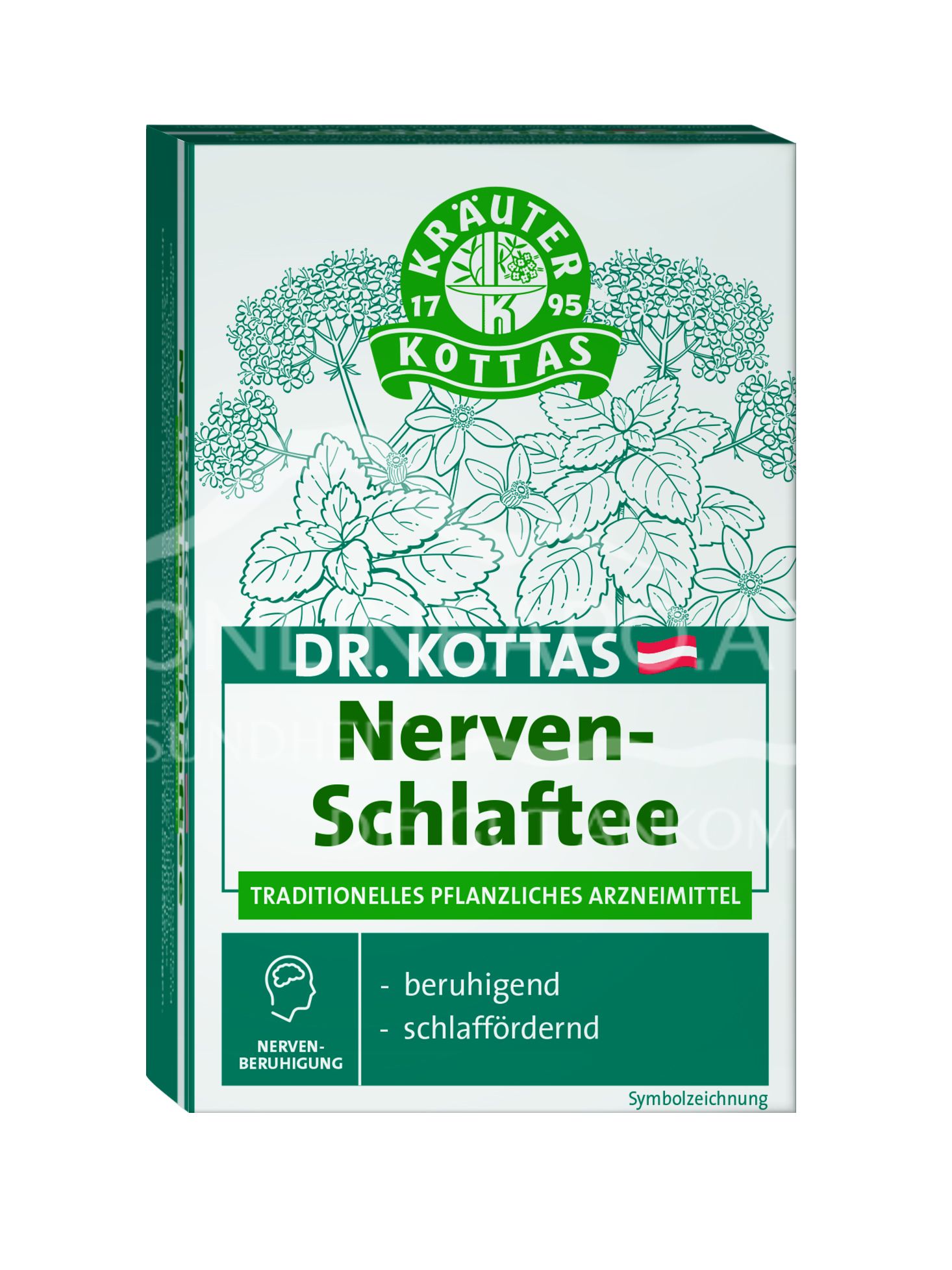
Dr Kottas Nerves Sleep Tea is a medicinal tea with the active ingredients orange blossom, lemon balm leaf, peppermint leaf, valerian root and liquorice root. For use in mild nervous restlessness, mild stress symptoms and difficulty falling asleep.
€6.40
(May vary by country)
Available, delivery time: 1-3 days ⁴
No parcel tax applies to your order from Onlineapo.at.
Dr Kottas’s Nervous System and Sleep Tea is a medicinal tea containing the active ingredients valerian root and lemon balm leaves. Valerian root has a relaxing effect and promotes sleep, whilst lemon balm leaves have a calming effect.
Dr Kottas’s Nervous System and Sleep Tea is a traditional herbal medicinal product for use in cases of mild nervous restlessness, mild symptoms of stress and difficulty falling asleep.
The use of this traditional herbal medicinal product for the aforementioned indications is based solely on long-standing use.
Valerian (Radix Valerianae)
- This robust, perennial plant grows to a height of over 1 m and is native to the whole of Europe and the temperate regions of Asia. It flowers from June to August, producing light pink to white flowers with a pleasant scent. The rootstock used medicinally (two-year-old plants are richest in active ingredients) develops a strong, characteristic odour when dried.
- Effect: Calming in cases of nervous agitation and restlessness, difficulty falling asleep, and nervous, cramp-like pain in the stomach and intestinal region.
Lemon balm (Folium Melissae)
- This perennial, usually highly branched plant grows to a height of around 30 to 70 cm. Its ovate leaves have a lemony scent and taste. The characteristic scent is due to the essential oil (whose main components are citral and citronella).
- Effect: Lemon balm has a calming effect and helps with nervous-related difficulty falling asleep and gastrointestinal complaints. Its antispasmodic effect relieves stomach and gallbladder complaints.
Peppermint (Folium Menthae piperita)
- Peppermint is a naturally occurring hybrid of two mint species (M. spicata and M. aquatica). It is sterile, meaning it cannot reproduce naturally. It was first discovered in England in 1696 in a field of spearmint and has been cultivated as seedlings ever since. It grows up to 90 cm tall and contains essential oil. The leaves give off a characteristic scent when crushed.
- Effects: The main active ingredient in peppermint is essential oil, particularly menthol. Peppermint leaves are used to treat colds and headaches; they also relieve cramp-like symptoms in the gallbladder area and the gastrointestinal tract.
Orange blossom (Flos Aurantii)
- The bitter orange or pomelo tree, much like the lemon tree, is a tree growing up to 5 m tall with evergreen leaves. The medium-sized, white to cream-coloured flowers are strongly scented with a sweet, heavy fragrance and are found in single or small clusters in the leaf axils. The roundish fruit has a diameter of 7–8 cm, is flattened at both ends and has a thick, rough, orange-coloured peel. The flesh tastes sour and bitter.
- Effects: Due to their calming and sleep-inducing properties, orange blossoms are excellent for treating states of agitation and sleep disorders. They also have a nerve-strengthening and stomach-soothing effect. They can be used to treat loss of appetite and digestive complaints, as well as gout and sore throats.
Liquorice (Radix Liquiritiae)
- Liquorice is a woody, perennial herb that grows up to 2 m tall. It has an extensive root system with a taproot. The bluish to pale violet papilionaceous flowers are arranged in spike-like, upright inflorescences. For medicinal purposes, the lateral roots, which are harvested and dried from late autumn to spring, are used.
- Effects: Glycyrrhizin, which is found in liquorice root, has cough-suppressant, anti-inflammatory and expectorant properties. Furthermore, it inhibits the growth of bacteria, fungi and viruses; therefore, liquorice root can also be used to treat coughs and inflammation in the mouth and throat.
Dosage form
Tea bags
Directions for use
Adults and adolescents aged 12 and over:
- For mild nervous restlessness and mild symptoms of stress: 1 cup of tea 3 times a day
- For difficulty falling asleep: 1–2 cups of tea half an hour before bedtime
Children aged 2–12 years:
- For mild nervous restlessness and mild symptoms of stress: 1 cup of tea twice a day
- For difficulty falling asleep: 1 cup of tea ½ hour before bedtime
- Pour boiling water over 1 tea bag per cup (125 ml), cover and leave to infuse for 10 minutes. Then squeeze the tea bag well and drink the tea lukewarm in small sips. The tea can be sweetened to taste.
- If symptoms worsen or there is no improvement after 14 days, consult a doctor.
- Use in children under 2 years of age is not recommended, as there is insufficient data available.
- If you have taken more Dr Kottas Nerve and Sleep Tea than you should
- To date, no cases of overdose with Dr Kottas’s Nervous System and Sleep Tea have been reported.
- Valerian root, at a dose of approximately 20 g (equivalent to about 31 tea bags), caused the following symptoms: tiredness, abdominal cramps, a feeling of tightness in the chest, drowsiness, trembling hands and dilated pupils. These symptoms subsided within 24 hours. No specific measures are known; treatment is symptomatic.
- If symptoms of an overdose occur, you should consult a doctor.
- If you have any further questions about the use of this medicine, ask your doctor or pharmacist.
- Gastrointestinal complaints such as nausea and abdominal cramps have been observed.
Notes:
- If taken at the same time as other sleep aids or sedatives, including synthetic ones, the effects may be mutually enhanced. This combination requires medical assessment and supervision.
- The effects of this medicine may be enhanced by the simultaneous consumption of large amounts of alcohol .
- Driving and operating machinery: ! Warning: This medicine may impair your reaction times and your ability to drive. This is particularly true when taken in combination with alcohol.
Ingredients
1 filter bag contains: 0.64 g valerian root (Valerianae radix), 0.4 g lemon balm leaves (Melissae folium)
The other ingredients are: peppermint leaves (Menthae piperitae folium), orange blossom (Aurantii flos), liquorice root (Liquiritiae radix)
| Alcohol-free: | Not specified |
|---|---|
| Gluten-free: | Not specified |
| Lactose-free: | Not specified |
| Perfume: | Not specified |
| Piece: | 20 |
| Sugar-free: | Not specified |
| Vegan: | Not specified |
Instructions for use
| Type of use: | Pro Tasse 1 Filterbeutel mit kochendem Wasser übergießen, 10 min zugedeckt ziehen lassen, Filterbeutel gut ausdrücken und den Tee lauwarm schluckweise trinken |
|---|---|
| Field of use: | Traditionell pflanzlich bei milden, nervösen Unruhezuständen, Stress und Einschlafstörungen |
| Dosage: | Personen ab 12 Jahren 3mal tgl 1 Tasse Bei Schlafstörungen ½ Stunde vor dem Schlafengehen 1-2 Tassen Kinder ab 2 Jahren 2mal tgl 1 Tasse Bei Schlafstörungen ½ Stunde vor dem Schlafengehen 1 Tasse Für Kinder 2 Jahren nicht empfohlen |
| Properties and efficacy: | Entspannend, schlaffördernd, beruhigend |
| Side effects: | Übelkeit, Bauchkrämpfe |
| Special warnings for safe use: | Verkehrshinweis |
| Pregnancy and breastfeeding period: | Vorsicht |
Pregnancy information
| Use possible under careful supervision |
|---|
Breastfeeding information
| Breastfeeding possible under careful supervision |
|---|
Pictograms
| Caution: may affect ability to drive/use machines |
|---|
Customers also bought
Lagernd
Content: 20 Stück
€6.11*
Lagernd
Content: 20 Stück
€7.11*
Sofort verfügbar
Content: 20 Stück
€5.31*
Sofort verfügbar
Content: 20 Stück
€6.11*
Sofort verfügbar
Content: 20 Stück
€6.40*
Sofort verfügbar
Content: 20 Stück
€6.40*