
Mosquito Guard® Repellent Spray, 75 ML

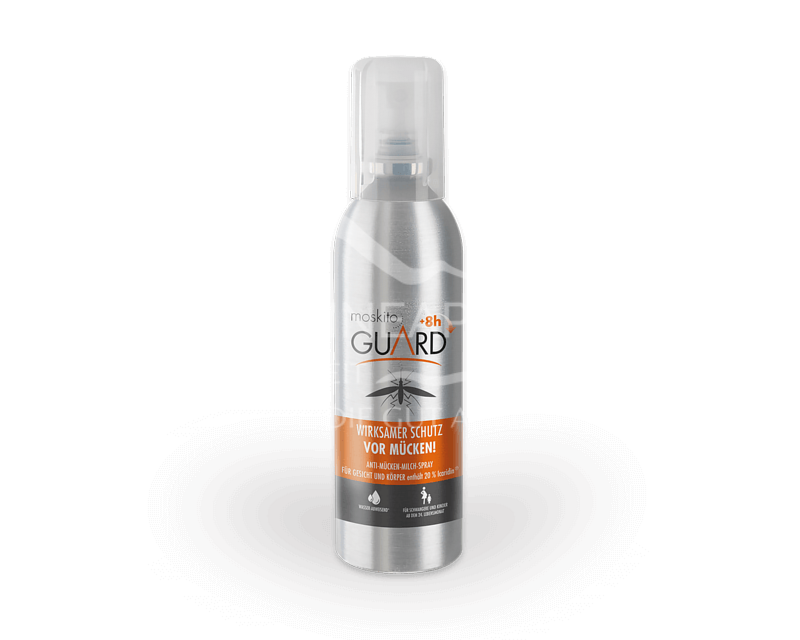
Mosquito Guard® Repellent Spray is a DEET-free insect repellent that is scientifically proven to protect against biting insects such as mosquitoes, sand flies and ticks. Gentle on your skin, but tough on mosquitoes.
€15.45
(May vary by country)
Available, delivery time: 1-3 days ⁴
No parcel tax applies to your order from Onlineapo.at.
- + 8 hours’ protection
- Pleasant scent
- Water-resistant
- Non-greasy
- DEET- and alcohol-free
- Contains 20% icaridin
- Suitable for pregnant women and children aged 2 and over
- Moisturising
- Icaridin is a synthetic compound that was developed to resemble the natural compound piperine. The alkaloid piperine is found in the plant group from which black pepper is derived.6 Icaridin is widely used as an insect repellent in Europe, Australia and the USA.6
- The active ingredient Icaridin is also known internationally under the trade names Saltidin and Picaridin.
- The active ingredient icaridin is a scientifically proven, effective alternative to DEET.1,7 In many cases, icaridin is better tolerated.7
- To prevent insect bites, the WHO recommends insect repellents containing either 20% DEET or ICARIDIN.8
- There are very few insect repellents based on Icaridin available on the Austrian market.
- This product is distributed in Austria by VALNEVA, a vaccine manufacturer and expert in travel medicine.
- Mosquitoes and sand flies1–3: Culex spp., Anopheles spp., Aedes spp., Phlebotomus spp.
- Ticks4,5: Ixodes spp., Hyalomma marginatum, Thipicephalus spp., Dermacentor spp. PLEASE NOTE – IMPORTANT INFORMATION: Using Moskito Guard® is by no means a substitute for the TBE vaccination!
- We hear a lot about DEET. Everyone recommends it. Many people use it. Is a DEET-based product really the product of choice, or do we simply not know the alternatives to DEET?
- Have you ever heard of an insect repellent that has a pleasant scent, is non-greasy and contains NO DEET or alcohol? Moskito Guard® with 20% icaridin is definitely an effective alternative, which also offers a number of other benefits.
Dosage form
Application
- Moskito Guard® is suitable for use on the face and body. As an emulsion in an aerosol can, it is easy to apply and stands out from the crowd with its pleasant fragrance.
- Shake well before use. Apply to all exposed areas of skin.
- Notes: Do not spray directly onto the face. Reapply every 8 hours, or more frequently during prolonged swimming or in high humidity. Suitable for children aged 28 months and over. Suitable for pregnant women.
Ingredients
| ML: | 75 |
|---|
Instructions for use
Customers also bought
Sofort verfügbar
Content: 100 Milliliter
€17.20*
Lagernd
Content: 50 Milliliter
€24.21* €26.90*
Lagernd
Content: 50 Milliliter
€16.74*
Lagernd
Content: 30 Milliliter
€22.05* €24.50*

Lagernd
Content: 20 Milliliter
€17.91* €19.90*