
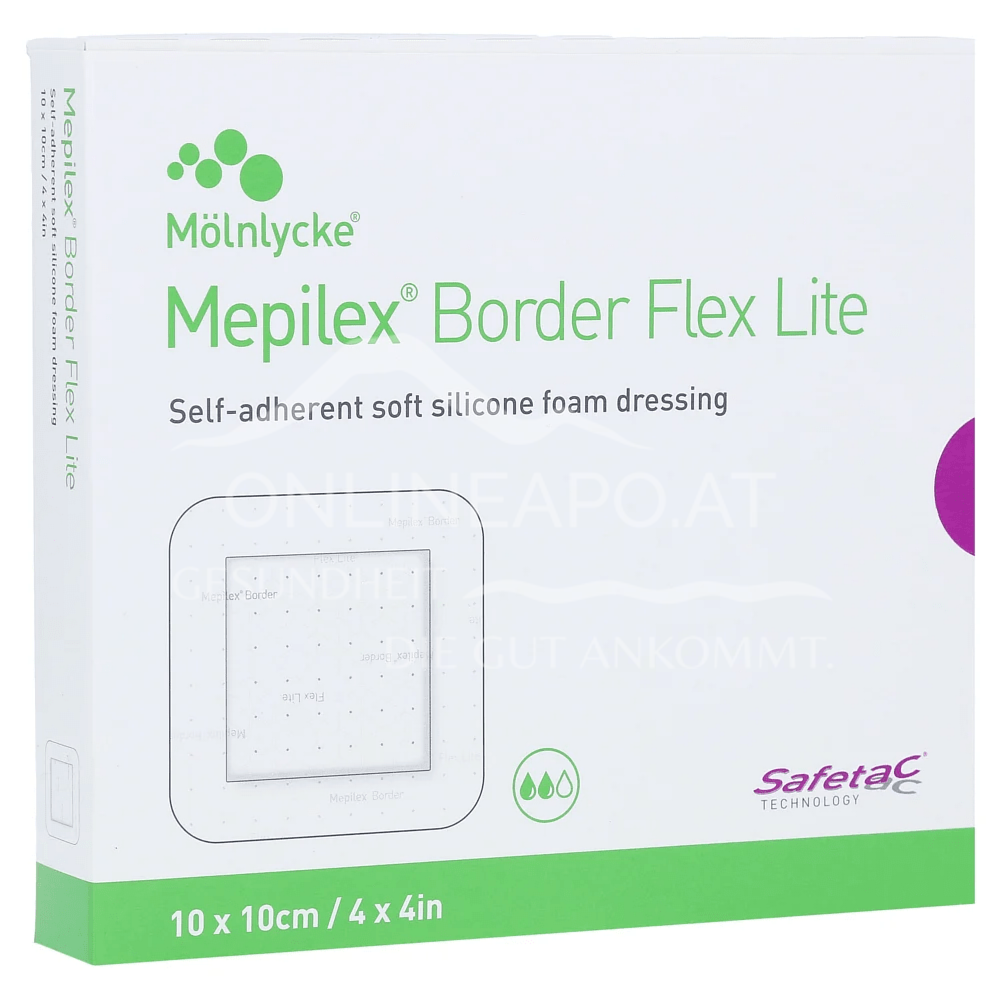
Mepilex® Lite Thin foam dressing sterile, 10 x 10 cm, 5 ST

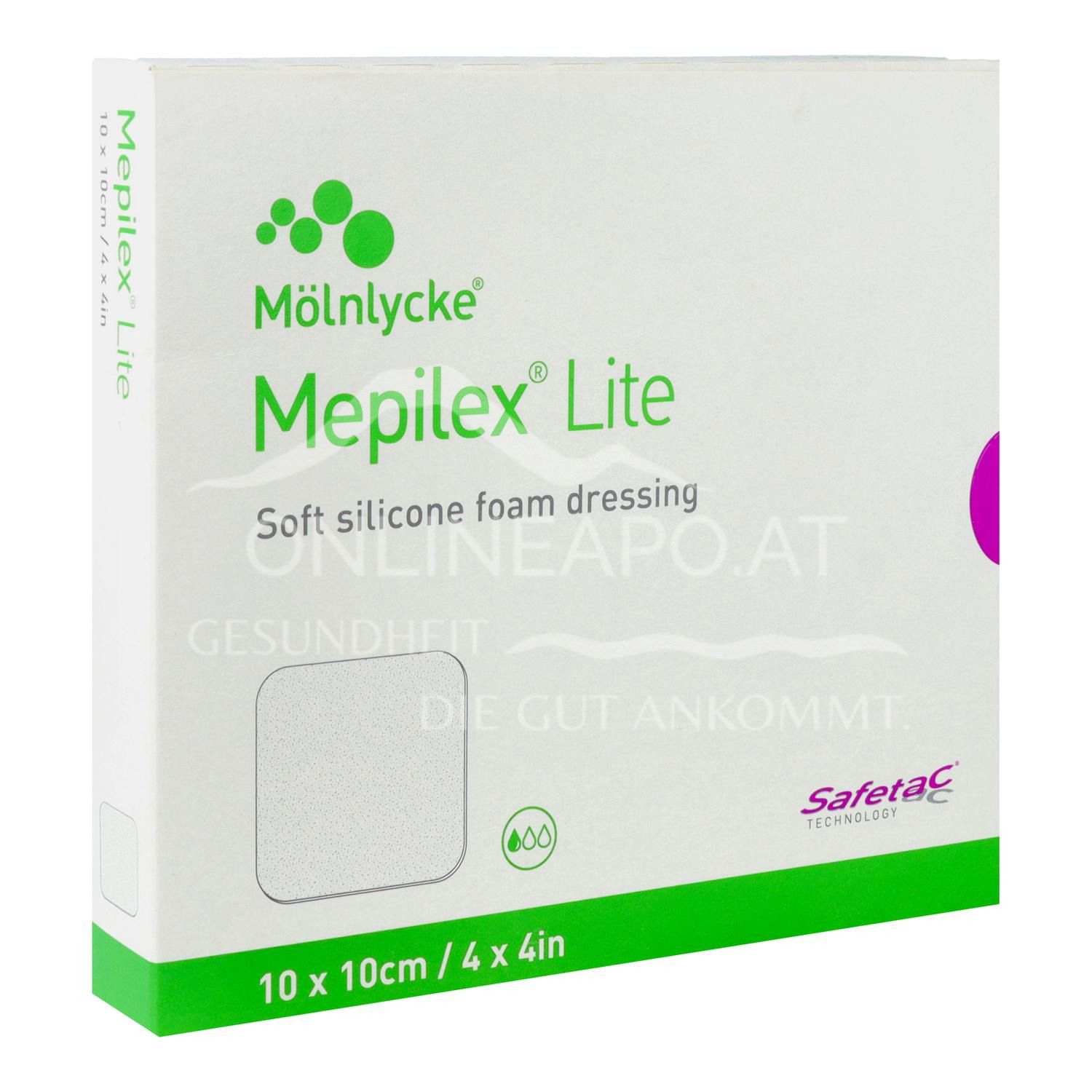
The Mepilex® Lite thin foam dressing sterile is an innovative solution for the treatment of slightly exuding acute and chronic wounds. With its unique Safetac® technology, it offers a painless dressing change.
€36.85
(May vary by country)
Ready to ship in 1-3 working days ⁴
No parcel tax applies to your order from Onlineapo.at.
The Mepilex® Lite Thin Foam Dressing, sterile, is an innovative solution for the treatment of low-exudate acute and chronic wounds. With its unique Safetac® technology, it enables pain-free dressing changes and promotes optimal wound healing.
How Mepilex® Lite works
Mepilex Lite is a highly adaptable dressing that effectively absorbs wound exudate and maintains a moist wound environment. Thanks to Safetac, the wound edges are sealed, preventing exudate from leaking onto the surrounding skin and minimising the risk of maceration. Due to the Safetac properties, the dressing can be changed atraumatically and with minimal discomfort.
Features
- Minimises trauma and pain during dressing changes 1,2
- Conforms well to the body’s contours
- Can be used as skin protection, e.g. for radiation-induced skin damage 6,7,8 or fragile skin
- Safetac® coating: adheres gently to intact skin and not to thewound 1–4
- Polyurethane foam: Absorbs exudate, conforms to the body’s contours, structurally stable
- Polyurethane film: Vapour-permeable, water-repellent
- Proven to reduce pain during dressing changes and minimise skin damage 1–4
Benefits of Mepilex® Lite
- Gentle on the wound and the surrounding skin
- Minimises the risk of maceration 3
- Conforms well to the body’s contours
- Ensures a high level of comfort 5
- Maintains a moist wound environment
- Can be cut to size
Indications
Mepilex Lite is suitable for a wide range of non-exuding to lightly exuding wounds, such as leg and foot ulcers, pressure ulcers, partial-thickness burns, radiation-induced skin reactions or epidermolysis bullosa. Mepilex Lite can also be used to protect vulnerable and fragile skin. Mepilex Lite can be used under compression and in combination with gels.
1. White R., A multinational survey of the assessment of pain when removing dressings. Wounds UK 2008; Vol 4, No 1. 2. Dykes PJ et al. Effects of adhesive dressings on the stratum corneum of the skin. J Wound Care 2001; 10(2):7–10. 3. Dykes PJ. The effect of adhesive dressing edges on cutaneous irritancy and skin barrier function. J Wound Care 2007, 16(3):97–100. 4. Zillmer, R., Agren, M.S., Gottrup, F., Karlsmark, T. Biophysical effects of repetitive removal of adhesive dressings on peri-ulcer skin. Journal of Wound Care 2006;15(5):187–191. 5. Meuleneire, F. Management of diabetic foot ulcers using dressings with Safetac: a review of case studies. Wounds UK. 6. Diggelmann KV et al. Mepilex Lite dressings for the management of radiation-induced erythema: a systematic in-patient controlled clinical trial. The British Journal of Radiology, 2010. 7. Paterson D. et al. Randomised intra-patient controlled trial of Mepilex Lite dressings versus aqueous cream in managing radiation-induced skin reactions following mastectomy. Journal of Cancer Science & Therapy, 2012. 8. Paterson et al. Poster presentation at the 2nd European Society for Radiotherapy & Oncology (ESTRO) Forum, Geneva, Switzerland, 2013 2008;4(4):16–30.
Dosage form
Sterile foam dressing
Directions for use
- Clean the wound in accordance with medical standards and dry the skin surrounding the wound thoroughly. Remove the protective film.
- Apply the adhesive side to the wound. Do not stretch the dressing. Mepilex Lite should overlap the wound by at least two centimetres.
- If necessary, secure Mepilex Lite additionally with suitable fixatives, e.g. Tubifast.
| Piece: | 5 |
|---|
Instructions for use
Customers also bought
Lagernd
Content: 10 Stück
€92.85*
Lagernd
Content: 1 Stück
€50.40*
Lagernd
Content: 250 Milliliter
€11.20*
Lagernd
Content: 5 Stück
€43.00*
Lagernd
Content: 25 Gramm
from €33.25*
Auf Bestellung
Content: 1 Stück
€11.20*