
Effipro 50 mg spot-on solution for cats, 4 ST

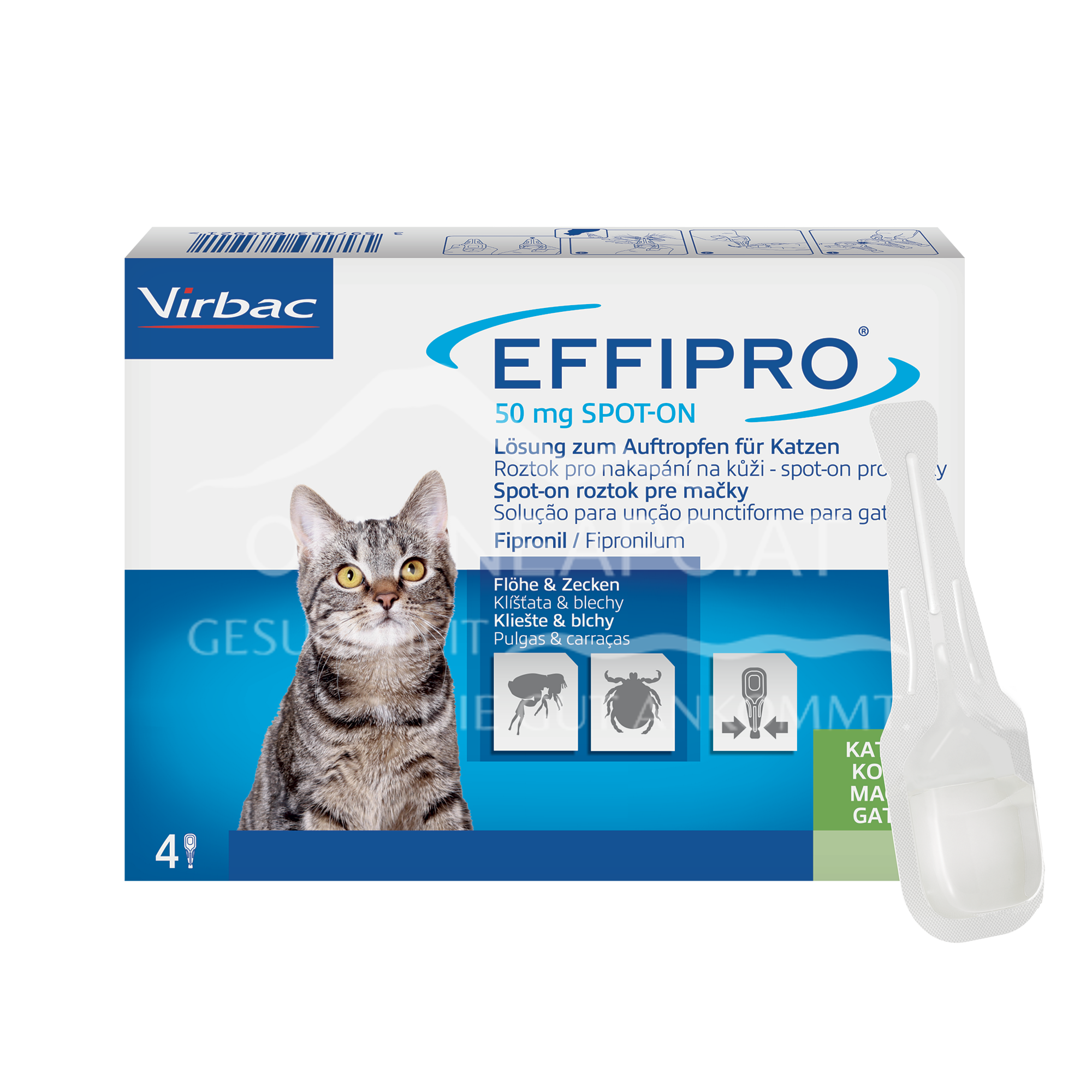
Effipro 50 mg spot-on solution for cats is a veterinary medicinal product for the treatment of flea (Ctenocephalides spp.) and tick (Dermacentor reticulatus) infestations.
€28.65
(May vary by country)
Ready to ship in 1-3 working days ⁴
No parcel tax applies to your order from Onlineapo.at.
Effipro 50 mg spot-on solution for cats is a veterinary medicinal product for the treatment of flea (Ctenocephalides spp.) and tick (Dermacentor reticulatus) infestations.
Treatment of flea (Ctenocephalides spp.) and tick (Dermacentor reticulatus) infestations. The veterinary medicinal product has a persistent acaricidal effect of up to 2 weeks against ticks (Rhipicephalus sanguineus, Ixodes ricinus, Dermacentor reticulatus). With certain tick species (Rhipicephalus sanguineus and Ixodes ricinus), not all ticks may be killed within the first 48 hours after application, but only within a week.
Indications for use
- For the treatment of flea (Ctenocephalides spp.) and tick (Dermacentor reticulatus) infestations.
- The veterinary medicinal product has a persistent insecticidal effect of up to 5 weeks against fleas (Ctenocephalides felis).
- The veterinary medicinal product has a persistent acaricidal effect of up to 2 weeks against ticks (Rhipicephalus sanguineus, Ixodes ricinus, Dermacentor reticulatus). In the case of certain tick species (Rhipicephalus sanguineus and Ixodes ricinus), not all ticks may be killed within the first 48 hours after application, but only within a week.
- The veterinary medicinal product can be used as part of a treatment plan to control flea allergy dermatitis (FAD), if previously diagnosed by a veterinarian.
Dosage form
solution
Directions for use
For external use only.
Topical application to the skin 1 pipette of 0.5 ml per animal.
Dosage form:
Thermoformed pipettes:
- Hold the pipette vertically. Tap the narrow part of the pipette so that the entire contents are in the main part of the pipette. Bend the cap of the spot-on pipette along the marked line.
- Part the skin so that the skin is visible. Place the pipette tip on the skin and press the pipette several times to empty the contents directly onto the skin. Repeat the procedure on one or two other areas of the cat's neck, preferably at the base of the skull and between the shoulders.
Polypropylene pipettes:
- Remove the pipette from the packaging. Hold the pipette vertically and remove the cap by twisting and pulling it off. Turn the cap round and place the other end of the cap back on the pipette. Twist the cap to break the seal, then remove the cap from the pipette.
- Part the skin so that the skin is visible. Place the pipette tip directly on the skin and squeeze the pipette several times to empty the contents directly onto the skin. Repeat the procedure on one or two areas of the cat's neck, preferably at the base of the skull and between the shoulders.
- Applying the solution close to the base of the skull reduces the possibility of the animal licking the solution off. Care should be taken to ensure that the animals do not lick each other after treatment.
- The coat should not be excessively soaked as this will stick the hair to the application site. However, if this occurs, it will disappear within 24 hours of treatment. A whitish solution residue may be visible up to 48 hours after treatment.
Tips for correct treatment
Treatment plan: For optimal elimination of flea and/or tick infestations, a treatment plan can be drawn up according to the epidemiological conditions on site. As no tolerance studies are available, the minimum waiting time until the next treatment is 4 weeks.
Ingredients
- One 0.5 ml pipette contains: Active substance(s): Fipronil 50.00 mg.
- Other ingredients, knowledge of which is necessary for the proper administration of the product: Butylhydroxyanisole (Ph. Eur., E320) 0.10 mg, Butylhydroxytoluene (Ph. Eur., E321) 0.05 mg.
Special warnings
- Fleas from pets often infest the bedding, storage and resting places such as carpets and upholstered furniture. In case of intensive infestation and at the beginning of the control measure, these places should therefore be treated with a suitable insecticide and vacuumed regularly.
- The veterinary medicine does not prevent individual ticks from infesting the animal. However, these ticks are killed in the first 24-48 hours. They are usually killed before they are fully engorged, so that the risk of tick-borne disease can be reduced, but not completely ruled out. Once the ticks are killed, they generally fall off the animal and any remaining ticks can be removed with gentle traction.
- Data on the influence of bathing/shampooing on the efficacy of the veterinary medicinal product in cats are not available. Based on data in dogs, it can be concluded that shampooing one hour before treatment does not affect the efficacy of the veterinary medicinal product against fleas.
- As part of a treatment plan for flea allergy dermatitis, monthly applications are recommended for the allergic animal and other cats living in the household.
- For optimal control of the flea problem in a multi-pet household, all dogs and cats should be treated with an authorised insecticide.
Special precautions for use on animals
- Avoid contact with the animal's eyes. If the veterinary medicinal product accidentally gets into the eyes, they must be rinsed immediately and thoroughly with water.
- Do not apply the veterinary medicinal product to wounds or skin lesions.
Special precautions for the user: This veterinary medicinal product may cause irritation of the mucous membrane and eyes. Therefore, contact with the mouth or eyes should be avoided. If the veterinary medicinal product accidentally gets into the eyes, they must be rinsed immediately and thoroughly with water. If eye irritation persists, seek medical advice immediately and show the package leaflet or the label. Avoid contact with the skin. If the veterinary medicinal product accidentally gets on the skin, it must be washed with soap and water. Wash hands after use. Do not eat, drink or smoke during application. Animals or users with known hypersensitivity to fipronil or any of the other ingredients should avoid contact with the veterinary medicinal product. Avoid direct contact with the application site while it is still moist. Children should be kept away from the treated animal during this time. It is therefore recommended to treat animals in the early evening rather than during the day. In addition, freshly treated animals should not sleep with their owners, especially children.
Other precautions: The alcoholic carrier solution may attack certain materials, e.g. painted, varnished or other surfaces or furniture. Use during pregnancy, lactation or the laying period Laboratory studies with fipronil have not shown any evidence of teratogenic or embryotoxic effects. No studies have been conducted with this veterinary medicinal product in pregnant and lactating cats. It should therefore only be used during pregnancy and lactation after an appropriate risk-benefit assessment by the attending veterinarian.
Special precautions for the disposal of unused medicinal product or waste materials, if necessary: Expired or incompletely emptied packs should be treated as hazardous waste and disposed of in accordance with the applicable regulations. Empty packs should be disposed of with household waste. Fipronil must not be allowed to enter bodies of water as it may pose a risk to fish and other aquatic organisms.
Contraindication: Due to lack of data, it is recommended not to use the veterinary medicinal product in kittens younger than 2 months and/or lighter than 1 kg. Do not use in sick (systemic diseases, fever...) or recovering animals. Do not use in rabbits, as side effects and even death may result. Do not use in case of hypersensitivity to the active substance or any of the other ingredients.
Side effects: If the animal licks the solution, increased salivation may occur for a short time due to the carrier solution. Extremely rare side effects include temporary skin reactions at the application site (dandruff, local hair loss, itching, reddening of the skin) and generalised itching or hair loss. In some exceptional cases, increased salivation, reversible neurological symptoms (hypersensitivity, depression, nervous symptoms) or vomiting have been observed after use. If you notice any side effects in your pet, especially those not listed in the package leaflet, report them to your vet or pharmacist.
Special storage instructions: Keep medicine out of reach of children. Store below 30°C. Store in a dry place. Do not use the medicinal product after the expiry date which is stated on the container and outer packaging.
| Alcohol-free: | Not specified |
|---|---|
| Gluten-free: | Not specified |
| Lactose-free: | Not specified |
| Perfume: | Not specified |
| Piece: | 4 |
| Sugar-free: | Not specified |
| Vegan: | Not specified |
Instructions for use
| Type of use: | Pipette öffnen, Haare scheiteln, Spitze von Pipette auf die Haut im Nackenbereich aufsetzen und Inhalt an mehreren Stellen entleeren An einer Stelle applizieren, die das Tier nicht ablecken kann |
|---|---|
| Field of use: | Floh-, Zeckenbefall, Flohallergiedermatitis als Teil einer Behandlungsstrategie bei Katzen |
| Dosage: | 1 Pipette mit 0,5 ml auf die Haut auftragen Mindestabstand 4 Wochen zwischen 2 Behandlungen |
| Properties and efficacy: | Lokales Ektoparasitikum insektizid, akarizid |
| Contraindications: | LogImport.sisx.GAD.Katzenwelpen unter 2 Monaten bzw 1 kg KG, kranke oder genesende Tiere, Kaninchen |
| Side effects: | Lokale Hautreaktionen, Juckreiz, Haarausfall, vermehrtes Speicheln, neurologische Symptome, Erbrechen |
| Special warnings for safe use: | Gegen Flohallergiedermatitis monatlich anwenden Nicht auf Wunden oder Hautläsionen anwenden |
| Pregnancy and breastfeeding period: | NutzenRisiko-Abwägung durch Tierarzt |
Customers also bought
Lagernd
Content: 4 Stück
€40.80*
Lagernd
Content: 10 Milliliter
from €29.90*