
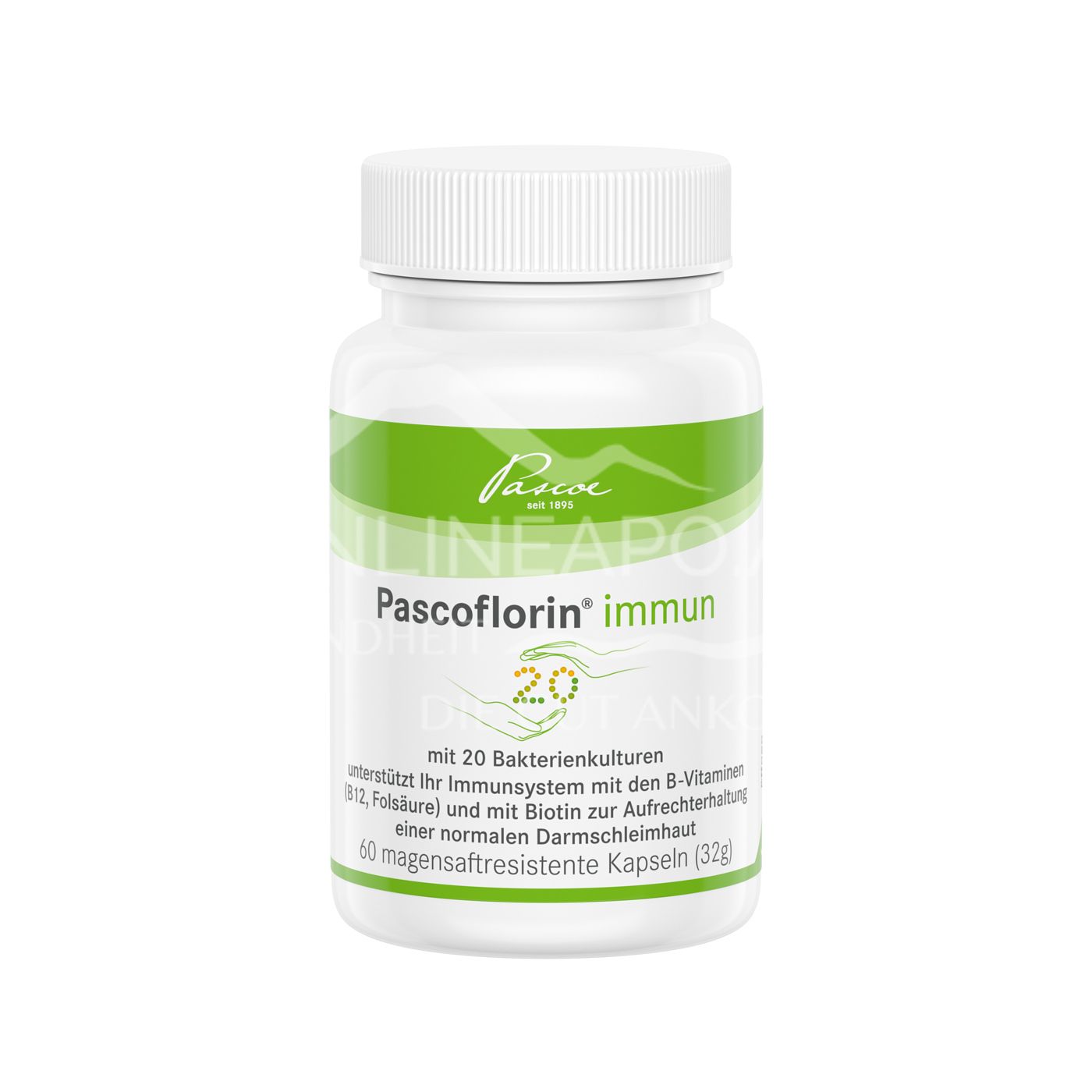
Pascoflorin® immune capsules, 60 ST

Skip image gallery
 Image/color similar
Pascoflorin® immune combines 20 bacterial cultures, inulin & B vitamins. The vegan capsules effectively support the immune system & intestinal mucosa. Gluten-free, lactose-free & enteric-coated - just 1 capsule a day for your inner balance and health.
Regular price:
€37.66
Content:
60 Stück
(€0.63 / 1 Stück)
(May vary by country)
Ready to ship in 1-3 working days ⁴
No parcel tax
No parcel tax applies to your order from Onlineapo.at.
Product number:
RA5192205
Stück:
Manufacturer:
Pascoe Vital GmbH
Product information "Pascoflorin® immune capsules"
Pascoflorin® immune combines 20 bacterial cultures, inulin & B vitamins. The vegan capsules effectively support the immune system & intestinal mucosa. Gluten-free, lactose-free & enteric-coated - just 1 capsule a day for your inner balance and health.
Food supplement with 20 bacterial cultures With B vitamins to support the immune system (vitamin B12 and folic acid)* and biotin to maintain a normal intestinal mucosa**.
The advantages of Pascoflorin immune at a glance:
- with 20 specially selected, reproducible, lactic acid-producing bacterial cultures
- with vitamin B12 and folic acid to support the immune system*
- also to accompany antibiotic therapy
- with biotin to maintain a normal intestinal mucosa**
- thanks to the enteric-coated capsule, the bacteria reach the intestine
- with inulin from the blue agave
- vegan
- without anti-caking agents such as silicon dioxide or magnesium stearate ("magnesium salts of fatty acids") and without colourings
- Made in Germany: manufactured in Germany***
- laboratory-tested quality
* Vitamin B12 and folate contribute to the normal function of the immune system ** Biotin contributes to the maintenance of normal mucous membranes *** In accordance with a new regulation regarding the designation of origin, we must point out that inulin does not originate from the EU.
Healthy centre - intestinal health is more than just good digestion
A healthy intestinal mucosa is not only important for the optimal utilisation of food, but also for our well-being. Intestinal health is a topic that concerns many people every day. It's good to know that everyone can contribute to this: With a balanced, high-fibre diet with plenty of fruit and vegetables, drinking enough fluids (at least 2 litres a day) and getting enough exercise, you can do yourself and your body a lot of good.
The intestinal immune system
In addition to its purely digestive function, the intestine and its intestinal mucosa are important components of the immune system. This essential task is obvious and vital, as the intestine forms the largest contact area with the outside world with a surface area of approx. 400 m2. This function is guaranteed by the so-called intestinal barrier. It consists of the intestinal immune system with approx. 80% of the body's immune cells and a protective layer. This is formed by closely connected cells of the intestinal mucosa and a covering layer of mucus that harbours the intestinal flora - also known as the microbiome. This barrier distinguishes between what is harmless and what could be harmful and thus protects the body from unwanted intruders and harmful substances.
The intestinal barrier - strong and sensitive
What can affect the health of the intestinal mucosa and the local immune system?
- Chronic stress, both physical and psychological - which weakens the immune system and can lead to chronic inflammation of our intestinal mucosa, among other things
- unhealthy eating habits - too much, too fast, too fatty, too high in protein, too late, too short intervals between meals
- lack of exercise
- Medication, especially antibiotics, which not only attack pathogens but also healthy bacteria and therefore the protective layer of the intestinal mucosa
With vitamin B12 and folic acid
- Vitamins are vital micronutrients that the human body cannot produce itself. Water-soluble vitamins, such as the B vitamins, cannot be stored. They must therefore be taken regularly with food. The advantage: water-soluble vitamins cannot be overdosed.
- A healthy and varied diet is important for vitamin B intake. All green vegetables and salads, for example, are rich in folic acid. Spinach, broccoli, endive and pulses in particular contain high levels of folate. Vitamin B12 is found almost exclusively in animal foods such as eggs, fish, meat and dairy products.
- The B vitamins are needed to maintain many functions and metabolic processes. They are important in connection with hormone production, influence blood circulation, are involved in the metabolism of carbohydrates, proteins and fat and contribute to haematopoiesis and healthy nerve function.
- Vitamin B12 is also known as cobalamin and is important for cell renewal, healthy nerves and the functioning of the immune system. Vitamin B12 is also important for the activation of folic acid*.
- Folic acid is also known as vitamin B9. The cell vitamin is important for all growth processes involving cell division and the immune system, among other things**.
* Vitamin B12 has a function in cell division. Vitamin B12 contributes to the normal function of the nervous system. the immune system ** Folic acid contributes to the normal function of the immune system. Folic acid has a function in cell division.
With biotin
Biotin is also commonly known as vitamin H or vitamin B7. Like vitamin C and the other vitamins in the B group, biotin is water-soluble, so it is not stored in the body and must therefore be taken daily. Among other things, biotin helps to maintain a normal intestinal mucosa and is important for a normal metabolism and nervous system*. Biotin is found in foods such as dried yeast, beef liver, egg yolk and oatmeal.
* Biotin contributes to
- the maintenance of normal mucous membranes
- the maintenance of normal skin
- to the maintenance of normal hair
- normal energy metabolism
- to a normal function of the nervous system
- to a normal metabolism of macronutrients
- for normal psychological function
Food supplement with 20 lactic acid bacteria cultures:
- Bifidobacterium bifidum - Bifidobacterium breve - Bifidobacterium infantis - Bifidobacterium lactis - Bifidobacterium longum - Lactobacillus acidophilus - Lactobacillus brevis - Lactobacillus casei - Lactobacillus crispatus - Lactobacillus fermentum - Lactobacillus gasseri - Lactobacillus helveticus - Lactobacillus paracasei - Lactobacillus plantarum - Lactobacillus reuteri - Lactobacillus rhamnosus - Lactobacillus salivarius - Lactococcus lactis susp. lactis - Streptococcus thermophilus - Enterococcus faecium Each capsule contains 1 billion (1 x 10⁹) CFU* * Colony-forming units (live germs capable of reproduction)
Dosage form
capsules
Directions for use
- One capsule per day.
- If you are taking antibiotics at the same time, do not take them for 2 hours. Do not exceed the recommended daily intake. The product should not be used as a substitute for a balanced and varied diet and a healthy lifestyle.
Ingredients
- Ingredients: Inulin, bulking agent: rice starch, glazing agent: hydroxypropylmethylcellulose and gelling agent: gellan (capsule shell); 20 lactic acid bacteria cultures*, nicotinamide, calcium D-pantothenate, pyridoxine hydrochloride, riboflavin, thiamine hydrochloride, folic acid, D-biotin, methylcobalamin * Bifidobacterium: B. bifidum, B. breve, B. infantis, B. lactis, B. longum, Lactobacillus: L. acidophilus, L. brevis, L. casei, L. crispatus, L. fermentum, L. gasseri, L. helveticus, L. paracasei, L. plantarum, L. reuteri, L. rhamnosus, L. salivarius; Lactococcus lactis susp. lactis; Streptococcus thermophilus; Enterococcus faecium.
- B vitamins per capsule NRV**: Niacin (NE) 3.2 mg 20%, pantothenic acid 1.2 mg 20%, vitamin B2 0.28 mg 20%, vitamin B6 0.28 mg 20%, vitamin B1 0.22 mg 20%, folic acid 40 µg 20%, biotin 10 µg 20%, vitamin B12 0.5 µg 20%.
- Number of lactic acid-producing bacteria per capsule: 1 x10⁹ CFU*. * Colony-forming units (living bacteria capable of reproduction).
| Gluten-free: | Yes |
|---|---|
| Lactose-free: | Yes |
| Piece: | 60 |
| Vegan: | Yes |
Read more
No reviews found. Share your insights with others.
Warnings - Pascoflorin® immune capsules
Instructions for use
Product recommendations for you