
Dr Schick Tick Forceps Ultra, 1 ST

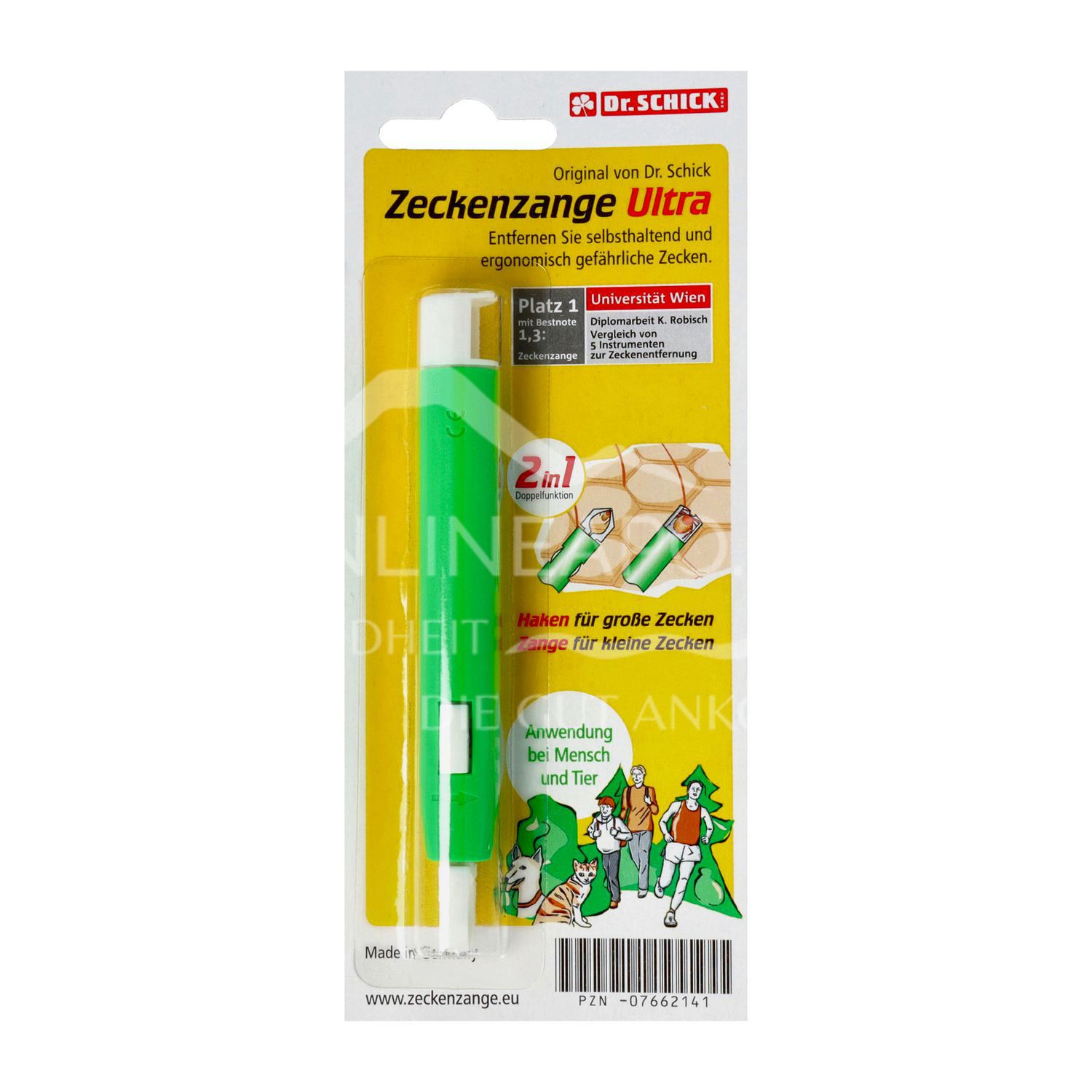
The Dr Schick Tick Forceps Ultra made of surgical steel is the ideal solution for the safe removal of ticks. Thanks to the patented technology, the tick is gently removed without squeezing the body. For humans and animals.
€5.95
(May vary by country)
Ready to ship in 1-3 working days ⁴
No parcel tax applies to your order from Onlineapo.at.
The Dr. Schick Ultra tick remover, made from surgical steel, is the ideal solution for the safe removal of ticks. Thanks to its patented technology, the tick is gently removed without crushing its body. For humans and animals.
Simple and safe tick removal – with the help of Dr. Schick’s tick tweezers
These tick tweezers are medical devices in accordance with Regulation (EU) 2017/745. This Regulation requires the manufacturer to assess and document the essential safety and performance requirements of the products, to carry out a clinical evaluation including a risk analysis, to draw up the technical documentation and the declaration of conformity, and, in particular, to conduct post-market surveillance (PMS/PCMF). We are grateful for any feedback from our customers regarding the removal technique we recommend. All the literature we are aware of indicates that the best and simplest way to remove the European tick Ixodes ricinus (‘common wood tick’) is to twist the tick out.
Ultra Tick Remover (surgical steel): Due to its firmer gripping pressure, this product is suitable for removing ticks from animals. The additional notch with a gripping pocket (as found, for example, on a tick card) allows for the easy removal of a fully engorged tick (approx. the size of a pea). The product is identical to the Ultra tick tweezers; however, the gripping jaws are made not of plastic but of high-quality surgical steel.
Form
Tick remover
Usage
Large parts of the tick’s mouthparts (often mistakenly referred to as the ‘tick’s head’) frequently break off and remain embedded in the skin. This can be avoided by twisting the tick out of the skin.
The twisting motion gently pulls out the barbs that are firmly anchored in the skin.
Simple and safe removal: grasp the tick as close to the skin as possible and slowly twist it out (approx. 2–3 full turns).
- Press the push buttons.
- Place the tweezers against the tick.
- Slowly twist the tick out.
- Disinfect the tick tweezers with 70 per cent alcohol after use.
- The bite site should also be disinfected after removing the tick. Removing the tick early (within 12 hours of the bite) can reduce the risk of infection.
You should seek medical advice following a tick bite: if localised redness (> 5 cm) or swelling develops at the bite site. if symptoms such as malaise, headache or fever (similar to flu-like symptoms) develop. if the tick could not be removed completely.
| Piece: | 1 |
|---|
Instructions for use
Customers also bought
Sofort verfügbar
Content: 100 Milliliter
€11.61* €12.90*
Sofort verfügbar
Content: 10 Stück
€9.30*
Sofort verfügbar
Content: 250 Milliliter
from €3.95*
Lagernd
Content: 125 Milliliter
€5.95*
Sofort verfügbar
Content: 125 Milliliter
from €12.90*