
Tubifast® tubular bandage with two-way stretch roll, blue, 7.5 cm x 10 m, 1 M

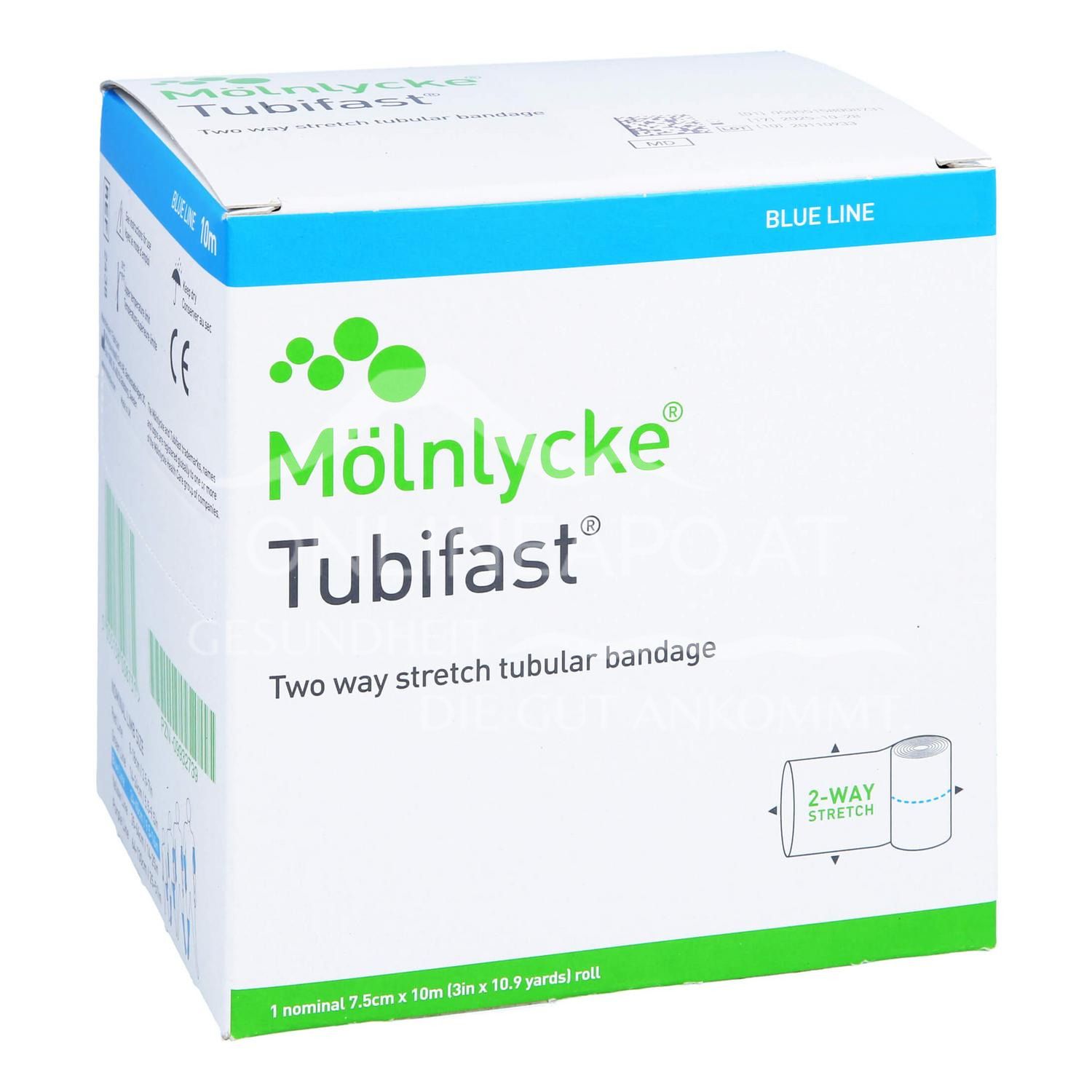
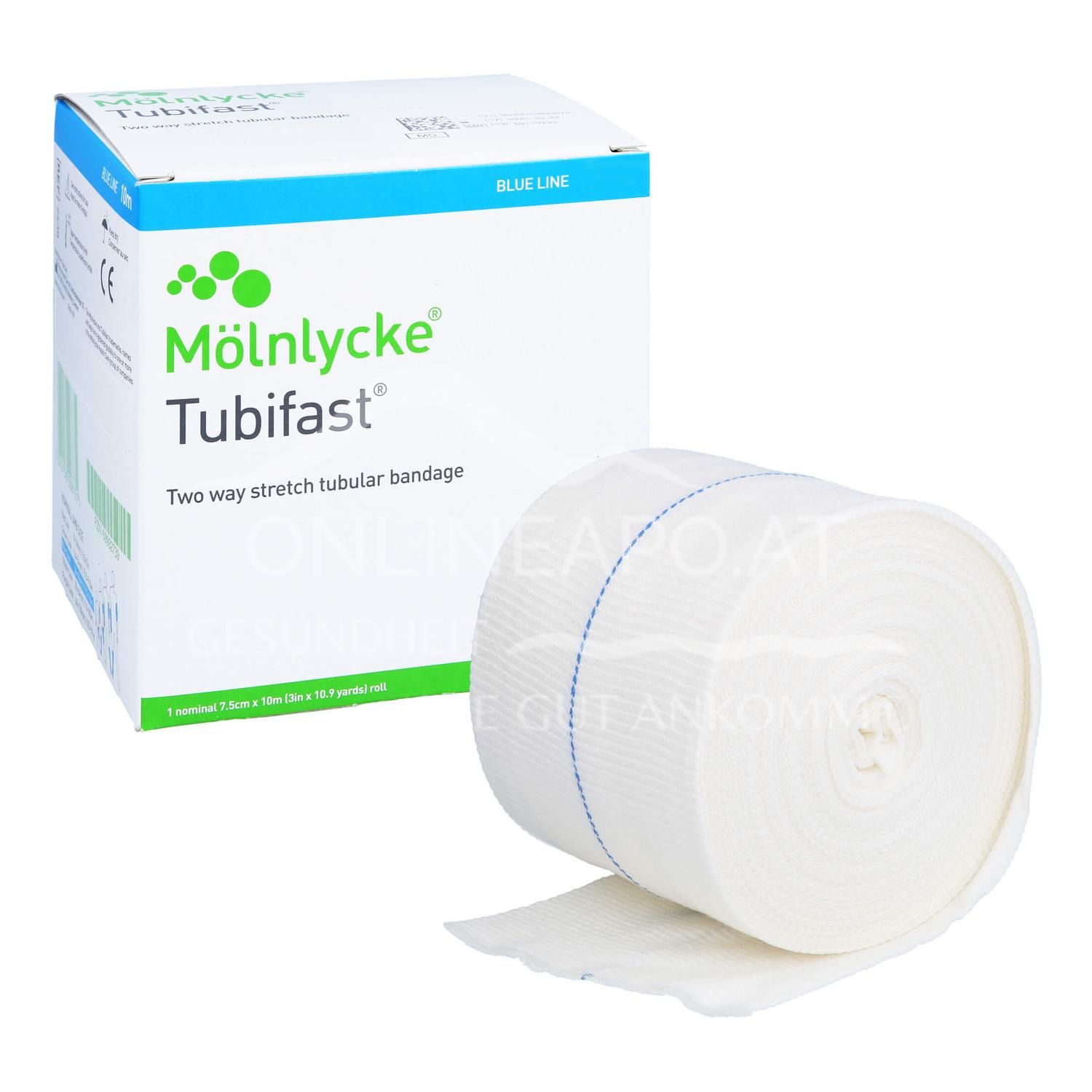
Tubifast® tubular bandages are the ideal choice for the quick and easy treatment of injuries. The soft, stretchy material offers optimum support and is comfortable to wear.
€4.55
(May vary by country)
Ready to ship in 1-3 working days ⁴
Tubifast® tubular bandages are the ideal choice for the quick and easy treatment of injuries. The soft, stretchable material provides optimum support and is comfortable to wear.
Tubifast 2-Way Stretch tubular dressings have been developed for securing dressings 1,2,3, securing wound dressings (wet or dry) 1,4,5,6,7,8,9, covering the skin 1-9 and as an under-pull stockinette 3. Tubifast is longitudinally and transversely stretchable and allows complete freedom of movement for patients.
Features
- Easy to use 1,3,5
- Lightweight, elasticated knitted fabric for good air circulation of the skin 3
- Can be cut to the desired shape 3
- Holds securely, no fastening with safety pins or adhesive tape required 3
- Non-sensitising and non-irritating 3
- Washable and reusable 3
- The slightly elasticated tubular bandage can be stretched lengthwise and crosswise thanks to 2-way stretch
Areas of application for Tubifast
- Tubifast with 2-Way Stretch Technology can be used as a dressing fixation and skin cover on all parts of the body. It can also be used as a tubular bandage and as an underdrawable stockinette. Thanks to its tubular construction, Tubifast with 2-Way Stretch Technology is particularly suitable for securing dressings in difficult areas, such as the residual limbs of patients with amputations.
1 Eytier C, Gazeau E, Beneteau G, Verfaillie G. Convenience and tolerance of the combination of a soft silicone foam dressing and a two-way stretch tubular bandage in the management of local wounds. Journal des plaies et cicatrisations 2013;18(88):38-44. 2 Harding KG, Vanscheidt W, Partsch H, Caprini JA, Comerota AJ. Adaptive compression therapy for venous leg ulcers: A clinically effective, patient-centred approach. International Wound Journal. 2016;13(3):317-25. 3 Mölnlycke Health Care. Data on file. 4 Hung C-J, Lin M-H, Lai P-J. The feasibility and effectiveness of outpatient home-based wet wrap therapy: A retrospective study from Asia. Journal of the American Academy of Dermatology. 2019;81(4):AB133. 5Leloup P, Stalder JF, Barbarot S. Outpatient home-based wet wrap dressings with topical steroids with children with severe recalcitrant atopic dermatitis: A feasibility pilot study. Pediatric Dermatology. 2015;32(4):e177-e8. 6 McGowan R, Tucker P, Joseph D, Wallace AM, Hughes I, Burrows NP, et al. Short-term growth and bone turnover in children undergoing occlusive steroid ('wet-wrap') dressings for treatment of atopic eczema. Journal of Dermatological Treatment. 2003;14(3):149-52. 7 Pei AYS, Chan HHL, Ho KM. The effectiveness of wet wrap dressings using 0.1% mometasone furoate and 0.005% fluticasone proprionate ointments in the treatment of moderate to severe atopic dermatitis in children. Pediatric Dermatology. 2001;18(4):343-8. 8 Schnopp C, Holtmann C, Stock S, Remling R, Fölster-Holst R, Ring J, et al. Topical steroids under wet-wrap dressings in atopic dermatitis - A vehicle-controlled trial. Dermatology. 2002(204):56-9. 9 Wolkerstorfer A, Visser RL, De Waard FB, Van Spek D, Mulder PGH, Oranje AP. Efficacy and safety of wet-wrap dressings in children with severe atopic dermatitis: Influence of corticosteroid dilution. British Journal of Dermatology. 2000;143(5):999-1004.
Dosage form
- Tubular bandage, stretchable
- Width: 7.5 cm
- Circumference of limb: 24 - 40 cm
Application
- Select the correct width using the coloured markings and cut off the required length.
- Apply Tubifast 2-Way Stretch over the affected area.
- Cover the bandage with Tubifast 2-Way Stretch. Illustrated instructions are available for application to more complicated areas of the body.
| Piece: | 1 |
|---|
Instructions for use
Customers also bought
Content: 1 Meter
from €4.25*
Content: 1 Stück
from €11.25*
Content: 450 Milliliter
€25.10*