
Seewald Ortho Memory TriComplex Capsules, 60 ST

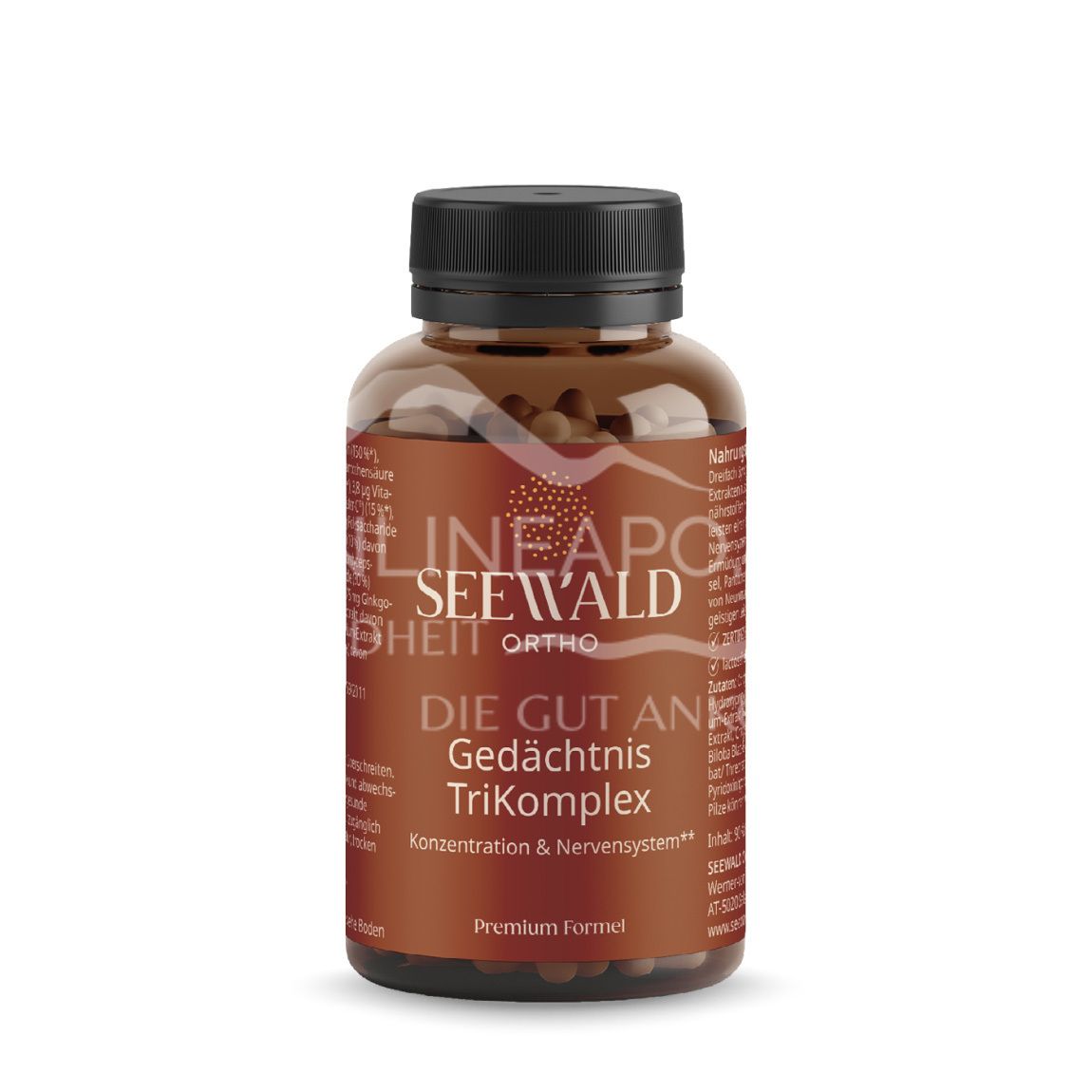
Seewald Ortho Memory TriComplex Capsules are a dietary supplement with high-quality medicinal mushroom extracts from chaga, cordyceps and hericium as well as B vitamins, vitamin C and the plant extracts ginkgo and ginseng root.
€37.70
(May vary by country)
Ready to ship in 1-3 working days ⁴
No parcel tax applies to your order from Onlineapo.at.
Seewald Ortho Memory TriComplex capsules are a dietary supplement containing high-quality medicinal mushroom extracts from chaga, cordyceps and hericium, as well as B vitamins, vitamin C and the plant extracts ginkgo and ginseng root.
As a dietary supplement, this complex contains vitamins, medicinal mushrooms, as well as ginkgo and ginseng. Pantothenic acid (vitamin B5) supports the normal metabolism of neurotransmitters and promotes normal mental performance. Vitamins B2, B3 (niacin) and C contribute to normal energy metabolism, the functioning of the nervous system and the reduction of tiredness and fatigue.
Medicinal mushrooms contain a wide variety of active biological substances and are regarded as multi-component mixtures. The polysaccharides, beta-glucans, triterpenes, polyphenols and bioactive proteins they contain are particularly noteworthy as complex and valuable constituents.
Compared to mushroom powder, mushroom extract contains, amongst other things, a higher amount of beta-glucans and polysaccharides. For SEEWALD’s Memory Performance Complex, we use special, high-quality mushroom extracts standardised to 30 % polysaccharides, with Cordyceps and Hericium additionally standardised to 20 % beta-glucans. Chaga extract contains 10% beta-glucans and a further 2% triterpenes. Cordyceps contains polysaccharides and cordycepin, a nucleoside.
Areas of application
To support:
- to mental performance and neurotransmitter metabolism
- to energy metabolism
- to reduce tiredness and fatigue
Vitamins from the B complex are usually found together in nature, where they enhance each other’s effects. The B complex vitamins include thiamine (vitamin B1), riboflavin (vitamin B2), niacin (vitamin B3), pantothenic acid (vitamin B5), pyridoxine (vitamin B6), biotin (vitamin B7), folic acid (vitamin B9) and cobalamin (vitamin B12). They are all water-soluble vitamins that play a part in many biochemical reactions in the human body. Water-soluble vitamins cannot be stored in the human body for long.
Vitamin B2 (riboflavin) contributes to the normal functioning of the nervous system, normal energy metabolism, the reduction of tiredness and fatigue, and the protection of cells from oxidative stress. It may cause a harmless yellow discolouration of the urine.
Niacin ( vitamin B3), vitamin B6 (pyridoxine) and vitamin B12 (cobalamin) contribute to the normal functioning of the nervous system, normal psychological function, normal energy metabolism, and the reduction of tiredness and fatigue. The body’s requirement for niacin depends on its energy needs. In the form of nicotinamide, it is considered to be better tolerated. Methylcobalamin is the biologically active form of vitamin B12 and is characterised by high bioavailability.
VitaminsB6 and B12 contribute to the normal functioning of the immune system.
Vitamin B5 (pantothenic acid) contributes to normal energy metabolism, to the reduction of tiredness and fatigue, and to normal mental performance. It is also involved in the synthesis and metabolism of certain neurotransmitters.
Vitamin C (calcium L-ascorbate (Ester-C®)) is best known for contributing to normal energy metabolism, the normal functioning of the nervous system and mental processes, and the reduction of tiredness and fatigue. Vitamin C contributes to the normal functioning of the immune system and to the protection of cells from oxidative stress.
Calcium L-ascorbate ( Ester-C®) is pH-neutral, maintains a constant vitamin C level over 24 hours and is characterised by rapid absorption and high bioavailability. Calcium L-ascorbate (Ester-C®) is pH-neutral, maintains a constant vitamin C level over 24 hours and is characterised by rapid absorption and high bioavailability. (Ester-C® and the Ester-C® logo are registered trademarks of The Ester-C Company)
Chaga ( Inonotus obliquus, slate chaga) is native primarily to the mountain forests of the subarctic regions of Russia, Scandinavia, Central and Eastern Europe, as well as Central Asia, Japan and Korea, and grows on deciduous trees, particularly birch. The famous medieval ruler and Grand Prince of Kiev, Vladimir II Vsevolodovich (1053–1125), known as Monomakh (the ‘Lone Warrior’), is said to have used chaga as early as his time. In the 15th century, chaga is mentioned as a traditional tea drink in Russia and has been a part of Russian folk medicine ever since. Chaga contains more than 200 active biological substances, including various polyphenols and specific triterpenes, as well as various polysaccharides and beta-glucans. Specific examples include melanin and sterols, such as ergosterol and lanosterol, and betulin, a soluble lignin derived from the birch, its host tree. Melanin is found in the outer, black layer of the fungus. Chaga has both a primary and a secondary fruiting body. The primary fruiting body initially grows invisibly beneath the tree bark and forms a sloping layer of pores, which also gives it its name, ‘slate-coloured iridescent polypore’. The secondary fruiting body forms several years before the primary fruiting body and is intended to cause the host tree to die. It is what is commonly referred to as chaga. In TCM, chaga is used as a fortifying tonic, which is also said to have a harmonising effect on the mind.
Cordyceps ( caterpillar fungus, Ophiocordyceps sinensis) was already a highly prized and almost priceless fungus as far back as the 15th century, after yak herders in Tibet observed that their livestock became extremely hardy and resilient after consuming it. The fungus grows wild in the Tibetan highlands at altitudes of 3,000 to 5,000 metres. Cordyceps extract can now also be obtained from mycelium. It is a parasite that infects the larvae of root borers (Hepialus spp.). Some species also use ants to disperse their spores. In traditional Chinese nutritional theory, it is regarded as supportive of Qi and Yang.
Hericium ( Hericium erinaceus, lion’s mane mushroom, monkey head mushroom) is regarded as an excellent edible mushroom with a pleasantly exotic flavour. It is found almost worldwide and is also native to Europe, although it is rather rare there. In the wild, Hericium is found on living trees or on dead wood. Methods for its cultivation were also developed in the 1950s. In traditional Chinese nutrition, it is highly valued, particularly for its general harmonising properties. Hericium contains polysaccharides, such as erinacin and hericenones.
Ginkgo extract is obtained from the green leaves of the ginkgo tree (Ginkgo biloba), which is also known as the silver plum, silver apricot or temple tree, and which are harvested in summer. The leaves and seeds have been used in traditional Chinese nutrition for over 2,000 years. Key constituents include flavonoids, proanthocyanidins, tannins and essential oils.
Ginseng ( Panax ginseng) is the turnip-like root of the Panax plant, which belongs to the Araliaceae family. Ginseng grows primarily in Korea, eastern Siberia and China, where it has been used and highly valued for many centuries. Active constituents found in the ginseng root include saponins (steroid glycosides), triterpenes and ginsenosides.
Dosage form
Capsules
Directions for use
2 capsules per day, ½ hour before a meal.
Ingredients
- Ingredients: Cordyceps extract (Ophiocordyceps sinensis), hydroxypropyl methylcellulose (capsule shell), Hericium extract (Hericium erinaceus), ginseng root extract, chaga extract (Inonotus obliquus), Ginkgo biloba leaf extract, nicotinamide, calcium L-ascorbate / threonate (Ester-C®), calcium D-pantothenate, pyridoxine hydrochloride, riboflavin, methylcobalamin.
- Composition per daily dose (2 capsules) %NRV*: Vitamin B2 2.1 mg 150 %, Niacin NE 24 mg 150 %, Pantothenic acid 9 mg 150 %, Vitamin B6 2.1 mg 150 %, Vitamin B12 3.8 μg 152 %, Vitamin C (Ester-C®) 12 mg 15 %, Chaga extract 180 mg – of which polysaccharides (30 %) 54 mg – of which beta-glucans (10 %) 18 mg – of which triterpenes (2 %) 3.6 mg –, Cordyceps extract 300 mg – of which polysaccharides (30 %) 90 mg – of which beta-glucans (20 per cent) 60 mg –, Ginkgo extract 75 mg –, Ginseng root extract 200 mg – of which ginsenosides (15 per cent) 30 mg –, Hericium extract 225 mg – of which polysaccharides (30 %) 68 mg – of which beta-glucans (20 %) 45 mg –. *Reference amount according to Regulation (EU) No 1169/2011
| Gluten-free: | Yes |
|---|---|
| Lactose-free: | Yes |
| Piece: | 60 |
| Vegan: | Yes |
Instructions for use
Customers also bought
Lagernd
Content: 90 Stück
€45.90*
Auf Bestellung
Content: 50 Milliliter
€18.10*
Lagernd
Content: 60 Stück
€37.70*
Sofort verfügbar
Content: 50 Milliliter
€23.90*
Sofort verfügbar
Content: 20 Milliliter
€17.90*