
Mepilex® Up Absorbent foam dressing sterile, 5 x 5 cm, 5 ST

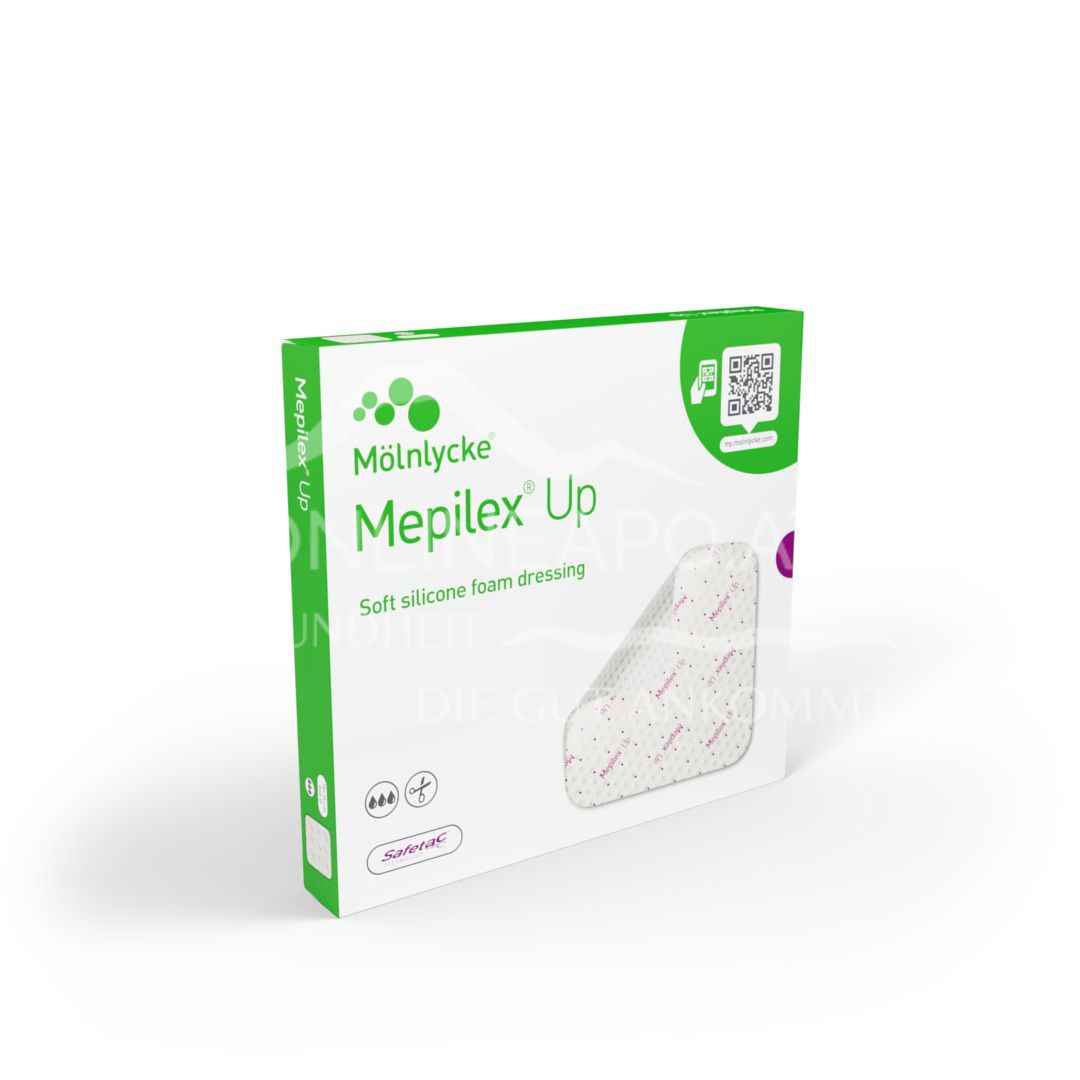
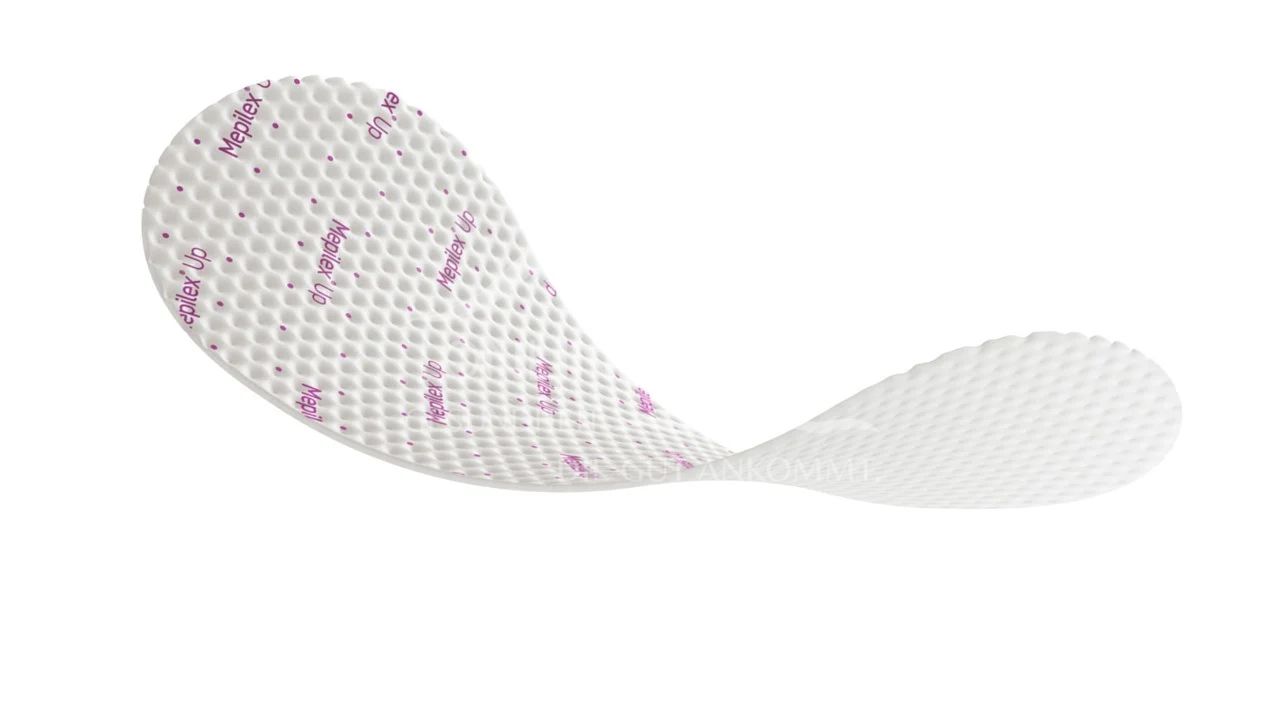
Mepilex® Up is an innovative foam dressing that minimises the risk of leakage and promotes optimal wound healing. Thanks to Safetac® technology, it adheres gently to the skin and protects the wound from external influences.
€23.65
(May vary by country)
Ready to ship in 1-3 working days ⁴
No parcel tax applies to your order from Onlineapo.at.
Mepilex® Up is an innovative foam dressing that minimises the risk of leakage and promotes optimal wound healing. Thanks to Safetac® technology, it adheres gently to the skin and protects the wound from external factors.
An innovative foam dressing that minimises the risk of leakage. 1–3
Mepilex® Up is a new and innovative foam dressing that minimises the risk of leakage.1 Despite its thin profile, Mepilex® Up can absorb large volumes of fluid.1–3 Thanks to its unique exudate distribution* 9, Mepilex® Up offers better fluid absorption than other foam dressings**.10 Its ability to distribute fluids evenly in all directions minimises the risk of leakage and provides reliable exudate management over several days.1–4
The patented Safetac® wound contact layer adheres gently to intact skin but not to the wound itself, thereby preventing damage to the skin surrounding the wound (e.g. skin stripping) and to the wound bed, and minimising the associated pain during removal.5–7, 12–14 Safetac seals the wound edges, thereby preventing exudate from leaking onto the skin surrounding the wound, which minimises the risk of maceration.5,7,12,14–16
- The innovative foam dressing with dimples enhances capillary action, allowing fluids to spread in all directions, even againstgravity¹⁻⁴
- Absorbs and distributes both low-viscosity and high-viscosity exudate Designed tominimise leakage¹
- Minimises the risk of maceration
- Thanks to its thin profile, it is highly adaptable and easy touse1–3
- Provides better fluid absorption than other foam dressings.** 10
- Can be used for a wide range of exuding wounds at all stages of healing.
- Can be cut to fit different wound shapes.
- Mepilex® Up replaces Mepilex® XT
When to use Mepilex Up
Mepilex is intended for the treatment of a wide range of exuding wounds at all stages of healing, e.g. venous leg ulcers (VLU) and diabetic foot ulcers (DFU). Depending on the wound, the dressing change interval may be several days. Mepilex can be used under compression dressings and in combination with gels.
* Comparison based on laboratory tests of Smith & Nephew Allevyn Gentle, Coloplast Biatain® Silicone NB, Convatec Aquacel® Foam and Essity Cutimed® Siltec® Plus, using the FLUHTE method
** Comparison based on laboratory tests of Smith & Nephew Allevyn Gentle, Coloplast Biatain® Silicone NB, Convatec Aquacel® Foam and Essity Cutimed® Siltec®, in accordance with EN 13726:2023 Annex E. 1. Lev-Tov H. A prospective, open, multi-centre, interventional, non-comparative clinical investigation to monitor the progress of exuding chronic wounds using Mepilex Up, Clinical Investigation Report – Diplo01. Mölnlycke Health Care. PD-737729 Rev 1. 2024. 2. Product Manual – Fluid management under compression for seven days, PD-741114, 2024. 3. Product Manual – Fluid Handling Management FLUHTE, PD-740012, 2024. 4. Product Manual – Absorption capacity using an inclined plane, PD-741137, 2024. 5. Zillmer R, et al. Biophysical effects of repetitive removal of adhesive dressings on peri-ulcer skin. J Wound Care 2006;15(5):187–191. 6. Waring M, et al. An evaluation of the skin stripping of wound dressing adhesives. J Wound Care 2011:20(9):412–422. 7. White R. A multinational survey of the assessment of pain when removing dressings. Wounds UK. 4(1). 2008. 8. Product Manual – Bending Length, PD-740005, 2024. 9. Product Manual – Fluid Handling Management FLUHTE, PD-741994, 2024. 10. Product Manual – Fluid Handling Capacity, PD-740029, 2024. 11. Gardener S, ‘Leaky legs’ is not a diagnosis! Impact of exudate on patients with venous leg ulcers, Journal of Community Nursing, 2024; 38(2):24. 12. Woo, K., Coutts, P.M., Price, P., Harding, K., Sibbald, R.G. A randomised crossover study of pain at dressing changes comparing two foam dressings. Advances in Skin and Wound Care 2009;22(7):304–310. 13. Rippon, M., Davies, P., White, R., ‘Taking the trauma out of wound care: the importance of undisturbed healing’. Journal of Wound Care 2012; 21(8): 359–368. 14. Upton, D., Solowiej, K. The impact of atraumatic versus conventional dressings on pain and stress. Journal of Wound Care. 2012;21(5):209–15. 15.
Van Overschelde, P. et al. A randomised controlled trial comparing two wound dressings used after elective hip and knee arthroplasty. Poster presentation at the 5th WUWHS Congress, Florence, Italy, 2016. 16. Bredow J. et al. Randomised clinical trial to evaluate the performance of a flexible, self-adherent, absorbent dressing coated with a silicone layer after hip, knee or spinal surgery, compared with a standard wound dressing. Poster presentation at the WUWHS Congress, Italy, 2016.
Dosage form
Sterile foam dressing
Use
- Clean the wound in accordance with clinical practice. Dry the skin surrounding the wound thoroughly. Select a suitable dressing size, taking the following points into account: For low-exudate wounds, the dressing should cover the skin surrounding the wound by at least 1 cm for small wounds and at least 3 cm for large wounds. For wounds with moderate to heavy exudate, the dressing should cover the skin surrounding the wound by at least 5 cm, regardless of the wound size. The dressing can be cut to suit different wound shapes and locations.
- Remove the first protective film. Apply the adhesive side to the wound. Remove the remaining protective film and smooth the dressing flat against the skin. Do not twist the dressing.
- If necessary, secure Mepilex Up with a dressing or other fixation method.
| Piece: | 5 |
|---|
Instructions for use
Customers also bought
Lagernd
Content: 10 Stück
€79.05*