
L-Mesitran® Tulle non-adhesive dressing with L-Mesitran Soft for animals, 10 x 10 cm, 10 ST

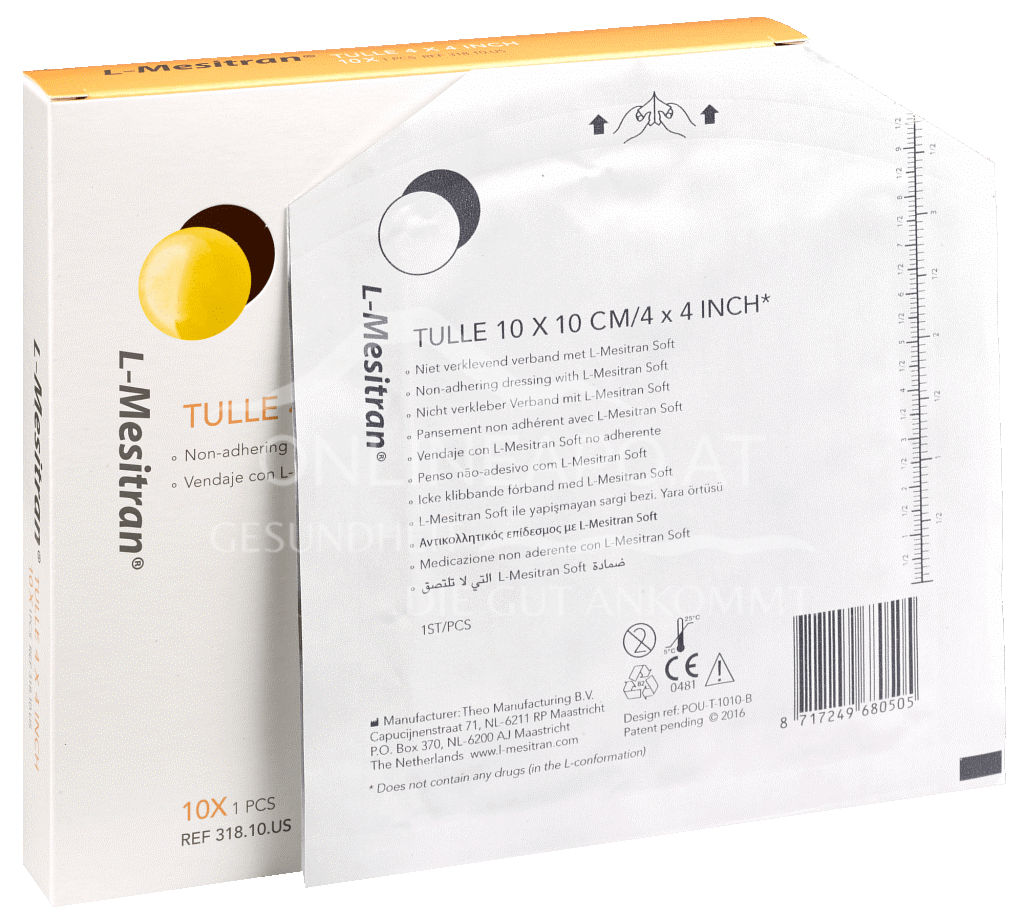
The L-Mesitran® Tulle non-adhesive dressing for animals, containing medicinal honey, protects the wound. The wound spacer allows for pain-free dressing changes.
€36.90
(May vary by country)
Ready to ship in 1-3 working days ⁴
The L-Mesitran® Tulle non-adhesive dressing for animals, containing medicinal honey, protects the wound. The wound spacer grid allows for pain-free dressing changes.
L-Mesitran Tulle is a non-adhesive polyethylene dressing impregnated with the patented L-Mesitran Soft gel, which consists of the following ingredients: 40% medicinal honey, hypoallergenic lanolin (Medilan), propylene glycol, PEG 4000 and vitamins C & E.
When the gel comes into contact with the wound, wound exudate is drawn from the surrounding tissue. This creates a moist wound-healing environment. This environment stimulates the wound-healing process: through autolysis, necrotic tissue and other debris are broken down, the wound bed is prepared and epithelialisation is stimulated.
Properties
- L-Mesitran Tulle has an antibacterial effect.
- The gel gradually diminishes and, if desired, can be easily removed in accordance with the applicable wound care protocol.
- L-Mesitran Tulle is a primary wound dressing that must be covered with standard secondary wound dressings.
- The properties of L-Mesitran Tulle ensure that the secondary wound dressing does not stick to the wound bed.
- As natural products are used, each batch of the gel may have a slightly different colour (white, yellow, brown).
- The gel may contain visible sugar crystals. However, this does not affect the efficacy and/or application of the gel.
- The white polyethylene dressing allows wound exudate to drain onto the secondary dressing.
Indications
- Superficial wounds, acute wounds (such as cuts and grazes), donor sites. Burns and laser wounds (1st and 2nd degree). Chronic wounds, such as pressure ulcers or venous, arterial and diabetic ulcers. Oncological wounds (to eliminate odours and remove necrotic tissue). Contaminated, acute wounds and (post-operative) surgical wounds.
Dosage form
Wound dressing
Usage
- Inspect and clean the wound, if necessary, in accordance with the applicable protocol.
- Remove the L-Mesitran Tulle dressing from the packaging and cut it to the required size if necessary.
- Remove both protective paper layers and apply L-Mesitran Tulle to the wound.
- Cover the L-Mesitran Tulle with a suitable secondary dressing. This will depend on the amount of exudate.
- Check the wound and the surrounding tissue as often as required by the applicable wound care protocol.
- If the patient does not tolerate L-Mesitran Tulle, remove it and clean the area around the wound thoroughly.
- Frequency of dressing changes: L-Mesitran Tulle can remain on the wound for several days. This depends on the amount of exudate. Change the dressing when the gel has disappeared. Where possible, L-Mesitran Tulle may remain in place whilst the secondary dressing is replaced. If the dressing has become dry, it can be removed more easily with the aid of a little moisture.
- Precautions: Do not use if the packaging is damaged or has been opened previously. Do not use after the expiry date. Consult a doctor if additional measures are required for wound care. Inspect and clean the wound in accordance with applicable regulations. Due to autolytic debridement, the wound may appear larger after the first few dressing changes. This is a normal phenomenon whereby dead tissue is removed. This prepares the wound bed for healing. Consult a doctor if the patient shows signs of infection (fever, pain) or if the condition of the wound deteriorates. Use L-Mesitran Tulle only once. Dispose of the dressing after use as described in the applicable protocol.
- Contraindications: No contraindications are currently known. The dressing must not be used on patients who are sensitive to the dressing or any of its components.
Ingredients
Material: The gel contains 40% medicinally active honey, hypoallergenic medical-grade lanolin, propylene glycol, PEG 4000, and vitamins C and E.
| Piece: | 10 |
|---|